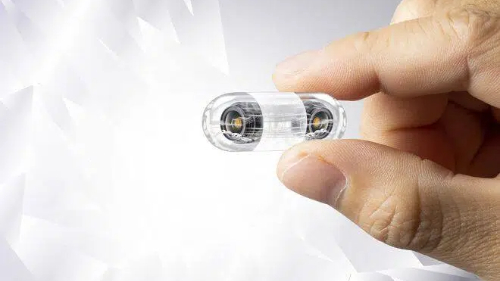
Swallowable sensors can continuously monitor gastrointestinal temperature
2026-06-17
A research team from the Massachusetts Institute of Technology (MIT) has developed a miniature swallowable sensor capable of continuously monitoring core body temperature within the gastrointestinal tract, transmitting data every second. This breakthrough offers a more precise new tool for infection early warning, anesthesia monitoring, and home-based health management. The study has been published in the latest issue of Nature Electronics.
In recent years, swallowable temperature sensors have entered the market, but most are as large as or even larger than composite vitamin capsules, making them difficult to swallow and posing a risk of gastrointestinal blockage. This limitation stems from their internally integrated complex circuits, which require large batteries for power supply, occupying most of the capsule’s volume.
This time, the research team miniaturized core components such as the temperature-measuring circuit, antenna, and battery, and introduced a low-power oscillating circuit based on leakage current, significantly reducing the device’s power consumption. Leakage current refers to the weak current that persists even when the circuit is turned off; its oscillation frequency changes with temperature variations.
The device can be integrated onto a silicon chip with an area of only 1 square millimeter, achieving a temperature measurement accuracy of 0.01℃ and a power consumption of approximately 10 nanowatts. Thus, it can be powered by a single button battery with a voltage of 1.55 volts, a diameter of 4.8 millimeters, and a thickness of about 1.6 millimeters.
To further reduce energy consumption, the team adopted a “backscatter” communication technology, shifting most energy demands to an external antenna. The external antenna transmits ultra-high-frequency radio waves, which are modulated by the sensor’s internal antenna and reflected back. By analyzing the signal changes, the body temperature value can be calculated. The device transmits temperature data every second, enabling continuous monitoring.
This sensor can be applied in multiple scenarios, including infection monitoring, intraoperative and postoperative anesthesia monitoring. It is also suitable for home environments, as well as for athletes, soldiers, and individuals who are long-term exposed to high or low-temperature environments.
In animal experiments, the team found that the sensor could accurately detect and transmit body temperature data, whether the subjects were under anesthesia or in a conscious and active state. (The Watchtower New Era)
Edit:WENWEN Responsible editor:LINXUAN
Source:Science and Technology Daily
Special statement: if the pictures and texts reproduced or quoted on this site infringe your legitimate rights and interests, please contact this site, and this site will correct and delete them in time. For copyright issues and website cooperation, please contact through outlook new era email:lwxsd@liaowanghn.com

 Recommended Reading Change it