From orchards to dining tables, ASEAN fruits accelerate their entry into the Chinese market
2026-06-17
In summer, from the banks of the Red River in Vietnam to the depths of coconut groves in Thailand, from orchards near the equator in Malaysia to the banks of the Irrawaddy River in Myanmar, batches of ASEAN fresh fruits cross mountains and seas, passing through ports such as Guangxi and Yunnan for customs clearance and distribution, and then distributed to various parts of the country, serving on the dining tables of more and more Chinese families.
How can ASEAN fruits accelerate their entry into the Chinese market from orchards to dining tables? Recently, reporters visited fruit wholesale markets, ports and harbors in Yunnan, Guangxi, Chongqing and other places to explore the answers behind the increasingly diverse fruit categories and affordable prices in ASEAN.
At the Jinma Zhengchang Fruit Wholesale Market in Kunming, Yunnan, Thai Golden Pillow Durian occupies the most prominent position in the fruit stall. A vendor surnamed Liu said that a few years ago, durian sold for over a hundred yuan per kilogram, but now it has dropped to below 40 yuan per kilogram during promotions. In the market, fruits from Southeast Asia such as mangosteen and rambutan can be seen everywhere.
Similar changes are happening in many parts of the country.
At the Haijixing Fruit Wholesale Market in Nanning, Guangxi, another durian opened amidst cheers from vendors and consumers, saying, "One hundred and eight durians, one hundred and seven emotional values. The recently popular "durian guy" on the internet has attracted many consumers to check in and purchase. Previously, I bought durian of the same size for 300 yuan, but now there are more varieties and more choices at different price points, "said buyer Zhong Yiqian.
In the sales area of a supermarket in Yuzhong District, Chongqing, plump fresh fruits are piled up into small hills, and many citizens and tourists are leaning down to choose.
According to Hu Zuoqin, the person in charge of the supermarket, in the past two years, the retail prices of most tropical fruits have continued to decline, with high-end imported fruits such as durian and mangosteen experiencing the most significant decline. Two years ago, the retail price of 3A grade mangosteen was mostly between 20 and 30 yuan per kilogram. Now, the daily selling price has dropped to 16 to 20 yuan, and during promotions, it can even be as low as 9.9 yuan per kilogram. The prices of mango, longan, jackfruit and other fruits also showed a steady downward trend.
The increasing variety of fruit categories and affordable prices in ASEAN are mainly due to the continuous release of institutional dividends.
China and ASEAN have been each other's largest trading partners for several consecutive years. With the deepening implementation of the Regional Comprehensive Economic Partnership (RCEP) and the continuous upgrading of the China ASEAN Free Trade Area, more and more ASEAN fruits are able to enter the Chinese market more conveniently.
The dividend brought by policies, for fruit trading enterprises, the intuitive change is cost reduction.
In recent years, Yunnan has continued to promote the application of RCEP certificates of origin, allowing enterprises to enjoy tariff benefits and effectively reduce import costs. According to Kunming Customs statistics, in the first five months of this year, Yunnan fruit import enterprises enjoyed a tax reduction of 2.882 billion yuan by using ASEAN origin certificates.
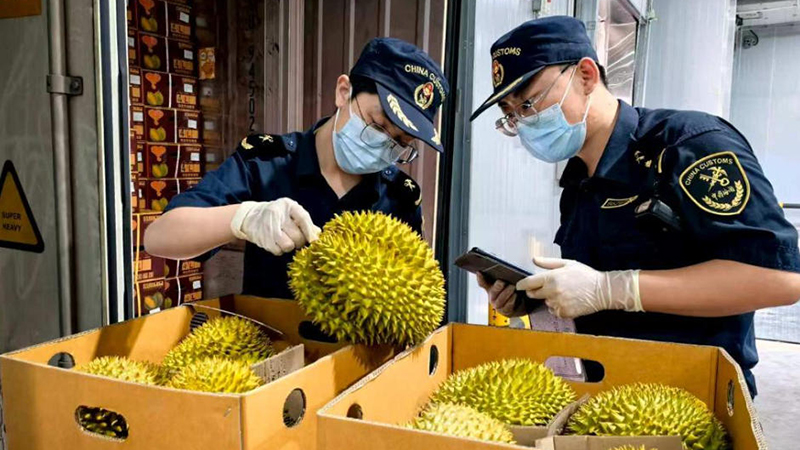
The institutional dividend has opened the door for ASEAN fruits to enter the Chinese market, and the continuously improving customs clearance efficiency has enabled fruits to be delivered to consumers faster. Customs in various regions continue to promote smart supervision and customs clearance facilitation reforms, seizing the "golden time" for ASEAN fruits.
The Yunnan "Single Window" public service platform has launched a "3 × 24-hour" customs clearance service, compressing the number of enterprise customs declaration data filling items from more than 100 to 20, and reducing the steps of general trade declaration from 6 to 2. At the Mohan Railway Port, container inspection systems and intelligent inspection equipment have been put into use, further improving customs clearance efficiency.
Li Jing, General Manager of Xishuangbanna Taihekun International Freight Forwarding Co., Ltd., said that under the promotion mechanism of cross-border transportation enterprise cooperation in the Greater Mekong Subregion, the customs clearance and sampling processes are efficient and convenient, significantly improving the efficiency of durian transportation. Fruits can enter the market in a more natural and mature state, better ensuring quality and freshness.
Data shows that in the first five months of this year, the value of imported fruits in Yunnan Province reached 9.02 billion yuan, a year-on-year increase of 46.9%, with durian, mangosteen, and fresh longan ranking among the top three.
The upgrading of the logistics system has improved transportation efficiency and further reduced the cost of tropical fruits entering the Chinese market.
At Guoyuan Port in Chongqing, a batch of fruits from ASEAN countries are sent to the national market after cold chain storage. Yang Liu, the person in charge of New Western (Chongqing) Agricultural Products Co., Ltd., introduced that in the past, Southeast Asian fruits mainly relied on sea transportation to enter China, with long transportation cycles and high loss rates. Now, the logistics networks such as the China Laos railway cold chain trains and the new land sea channel in the west are constantly improved, and the transportation efficiency is significantly improved.
Yang Liu said that in recent years, the comprehensive cost of logistics has decreased by 10% to 15%, and the rate of cargo damage has also decreased synchronously. Enterprises can pass on more concessions to consumers.
"Taking Durian as an example, it used to take more than ten days to enter China by sea, but now it can reach Kunming in 26 hours as soon as it passes the China Laos Railway 'Lancang Mekong Express'." Li Chaowei, director of the Department of Commerce of Yunnan Province, said that from January to May this year, the cross-border import water transported by the China Laos Railway reached 107900 tons, an increase of more than 30% year on year.
With the continuous improvement of logistics networks, Chongqing, Yunnan, Guangxi and other places are accelerating the construction of fruit distribution centers, and multiple key ports are operating day and night, becoming important channels for ASEAN fruits to enter the Chinese market.
He Daoguo, President of Chongqing Meilian International Warehousing and Transportation (Group) Co., Ltd., told reporters that after the distribution of ASEAN fruits in Chongqing, it can cover an area of 1000 kilometers around Sichuan, Guizhou, Hunan, Hubei and other regions, and basically achieve 24-hour delivery.
According to customs data, the import value of fruits and products in China reached 6.49 billion US dollars in the first four months of this year. Among them, the import value of durian increased by over 200% year-on-year.
Li Chaowei believes that with the continuous promotion of the China ASEAN Free Trade Area 3.0, the supply channels will become more diversified, and the level of industrial chain coordination will be further improved, which is expected to promote more ASEAN fruit categories to enter the Chinese market.
Edit:He Chuanning Responsible editor:Su Suiyue
Source:Xinhua
Special statement: if the pictures and texts reproduced or quoted on this site infringe your legitimate rights and interests, please contact this site, and this site will correct and delete them in time. For copyright issues and website cooperation, please contact through outlook new era email:lwxsd@liaowanghn.com

 Recommended Reading Change it