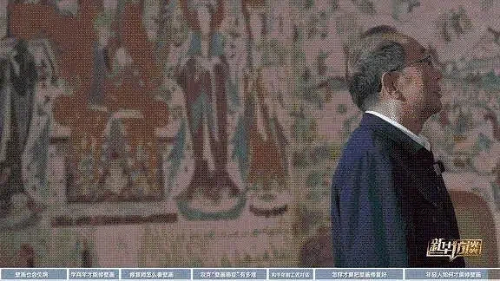
Fan Zaixuan: The person who "treats" the mural
2026-06-17
On the cliff at the west end of the Hexi Corridor, the Mogao Grottoes of Dunhuang have stood quietly for more than 1600 years. 735 caves are stacked layer by layer, and 45000 square meters of murals are slowly spread out.
But few people know that these stunning millennium old murals can also 'get sick'.
A few square meters of disease may take several months or even years to repair; A humidity value requires hundreds of repeated experiments. There are not many people in the country or even the world who can do this.
Fan Zaixuan, who is in his sixties this year, is a research curator at Dunhuang Academy and an expert in cultural relic protection and restoration. After thousands of years, the Mogao Grottoes of Dunhuang are the place he guarded for half his life; The square inch of the millennium mural is the root of the civilization he guards.
(1)
Compete with every inch of mural
The beauty of Dunhuang lies in the intricate lines of countless unknown artists, in the colors that have not been buried by thousands of years of wind and sand, and in the civilization and beliefs that have been accumulated at the intersection of the Silk Road.
In 1981, Fan Zaixian, in his early 20s, entered the Mogao Grottoes of Dunhuang for the first time. His eyes were filled with exquisite murals and colored sculptures. But when he became a restorer, he realized that this job was far more than just appreciating beauty - it was about preserving even the overlapping traces of millimeter level pigments.
Each type of mural disease is a different challenge, such as cracking, hollowing, and flaky alkali.
For example, cracking and nail formation are caused by the artist adding too much animal glue to the paint at that time. With changes in time and environmental conditions, the glue ages and cracks, and the paint layer is thick and brittle. When repairing, it is necessary to soften first, then inject adhesive material, and then gently reattach with a wooden knife. It must be tightly sealed and not show any cracks
For example, some pigment layers are as thin as cicada wings, rolled into small pieces after armor is lifted, and the injection needle is not much thicker than a strand of hair. "Every drop should be carefully injected behind the pigment layer," and hands should not shake at all during the process.
In the 85th cave of Mogao Grottoes, the disease is most concentrated and recurrent. Therefore, the protection team led by Fan Zaixuan has been working in this cave for a full 8 years.
They face the same wall inside the cave every day, bending down to search for diseases that are almost invisible to the naked eye. Every time they repair them, their movements are as light as touching a thin piece of paper. The cave was dimly lit and the environment was cold, but he didn't feel bitter: "I have always enjoyed immersing myself in a very relaxed environment in the cave." In this liking, there was another kind of competition - restoration not only required craftsmanship, but also science.
In order to overcome the disease known as "cancer" in murals, Fan Zaixuan and his team repeatedly explored and found that the culprit was the mixed soluble salts in the murals. When the humidity fluctuates, these salts undergo repeated deliquescence and crystallization. In order to identify that critical point, the team conducted a large number of simulation experiments and found that when the relative humidity of the environment is higher than 67%, the mixed soluble salts will deliquescence; Below it, the mixed soluble salts crystallize. More importantly, they also found a desalination material that can adsorb soluble salts from the murals, significantly reducing the content of soluble salts in the murals.
Over the past 45 years, Fan Zaixuan has personally restored five to six hundred square meters of murals and over 50 colored sculptures. In addition to the the Mogao Grottoes of Dunhuang, he also participated in the cultural relics protection project of the Potala Palace, Norbulingka, and Sakya Temple in Xizang. He has been on the plateau for many years, and the red blood on his face was left by ultraviolet rays.
Now when passing by Cave 85, he always stops to take a look and says, "The murals are very stable now, and I feel very at ease
After repairing a mural, the joy and happiness that allows so many people to continue to appreciate it, with extreme patience, allows the beauty of a thousand years ago to still be seen by more people today.
(II)
Engage in a millennium long dialogue with the craftsmen of that time
After staying in the Mogao Caves for a long time, Fan Zaixuan always felt that he was communicating with the painters from thousands of years ago. When repairing, he would think: Why did the painter at that time overlay red paint on top of green? Why is this ribbon painted like this? What would it look like if we changed the drawing method? It must have been the best way for him to handle it at that time. He didn't start repairing it until he felt like he had "understood" the painter from a thousand years ago.
The night sky in Dunhuang is quiet and deep. Sometimes when he looks up at the stars, he thinks more - over a thousand years ago, those painters in caves didn't even have electricity, perhaps relying only on an oil lamp, yet they painted such smooth and exquisite lines. Even if you take a flashlight in now, you may not be able to see clearly. How did they do it back then
This kind of dialogue that transcends time and space was most deeply felt during the restoration of the statue in Cave 9 of Maiji Mountain.
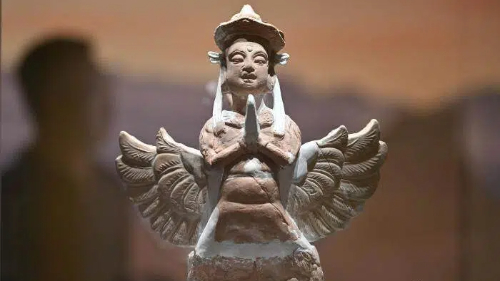
After receiving the task, Fan Zaixuan felt a lot of pressure. He has been repairing flat murals for decades, using syringes, wooden knives, adhesives, and his hands are as stable as machines. But three-dimensional, especially the eyes - with a slight deviation, the charm of the entire face is lost. The most difficult part of repairing eyes is not the shape, but rather the gaze. The audience stands below, the statue is on a high place, and the angle of lowered eyes must be just right, making people feel that it is communicating with themselves.
In order to repair his eyes, he plunged into medical books: orthopedics, musculoskeletal studies, anatomy, and psychology. Others find it strange, why study psychology when repairing statues? Fan Zaixuan explained, "Because you may wonder why the sculptors at that time made their eyes in this shape? The direction of their gaze and the angle of their lowered gaze. Why is that? You need to have a communication with them that transcends time and space in order to do it well
In the following three months, Fan Zaixuan led a team to repair the eyes of more than ten statues. Experts all say 'very good' after watching it. Fan Zaixuan said, "Our responsibility is to build a bridge of communication between the audience and the colored sculpture eyes
Fan Zaixuan has his own understanding of repair: "Only by combining repair and restoration can we call it repair
(3)
Transforming a 'job' into a 'lifelong career'
Someone asked Fan Zaixuan: Have you been living in the desert for more than forty years? Is it bitter?
I don't feel any pain, "he answered decisively." After restoring a piece of work, you are so happy, so joyful, and let so many people continue to appreciate it. It's very proud and fulfilling. "He said this feeling was" really good.
Actually, Fan Zaixuan came to Mogao Grottoes by chance. In 1981, he failed the college entrance examination and was planning to retake the exam when he saw a job posting on the street: Dunhuang Cultural Relics Research Institute was recruiting. He applied with a trial and error mentality, but unexpectedly got into the exam. Later, he found out that only twenty out of four to five hundred people were admitted.
At that time, it was purely for a job. But what really made him turn "a job" into a "lifelong career" was something that slowly entered his heart.
At that time, the conditions in Mogao Grottoes were harsh, with only one generator in the entire site and a power outage at 10 pm. But at that time, those elderly gentlemen in their forties and fifties would go to the office to read after dinner every day and only go home with flashlights after 10 o'clock; In order to copy and take photos in the cave without lighting, the old gentlemen would use several reflective plates to chase the sun and refract the light in order to take a decent photo. Young Fan Zaixuan was greatly touched in his heart, "I just thought, what reason do I have not to study? What reason do I have not to work hard
So he began to self-study college chemistry and studied for several years. Later, the unit sent him to Northwest Normal University, Fudan University, and Tokyo University of the Arts for further studies. My monthly salary is only over 50 yuan, but the company has to pay over 5000 yuan in tuition fees to send me out. I just thought, what kind of return can I get? The only way is to work hard and protect cultural relics
For the sake of Dunhuang, he refused the high salary and independent research laboratory treatment offered by Japan during the period of time. He said, "The Dunhuang Academy has put in so much effort to send me out. What is the reason for this? It's just that they hope I can study well and go back. There was no negotiation, so I came back
His WeChat account is called 'Facing the Wall for Thirty Years'. That started over a decade ago, and now he has been facing a wall for 45 years. At that time, choosing this name was like a few years ago. More than ten years have passed in a blink of an eye. Time flies too fast, and I always feel that I haven't put in enough. I keep pushing myself to live up to every inch and centimeter of the mural and work hard
As Fan Zaixuan understood the spirit of craftsmanship: "There is persistence in the heart, mastery in the hands, pursuit of perfection, and excellence
No matter how advanced technology is, it cannot be separated from this craftsmanship. The best protection is the integration of modern technology and traditional craftsmanship spirit. "When he said these words, his tone was flat, as if he was talking about which mural he had repaired today.
The young man who was amazed by the murals in the Mogao Grottoes of Dunhuang 45 years ago is now an old man guarding these murals. Outside the cave, the sandstorms of the Gobi Desert are still blowing; Inside the cave, the exquisite murals are still there, quietly beautiful. And Fan Zaixuan is still there - he hasn't left since the spring of 1981.(Outlook New Era)
Edit:Luoyu Responsible editor:Wang Erdong
Source:xinhuanet.com
Special statement: if the pictures and texts reproduced or quoted on this site infringe your legitimate rights and interests, please contact this site, and this site will correct and delete them in time. For copyright issues and website cooperation, please contact through outlook new era email:lwxsd@liaowanghn.com

 Recommended Reading Change it