
2026-06-17
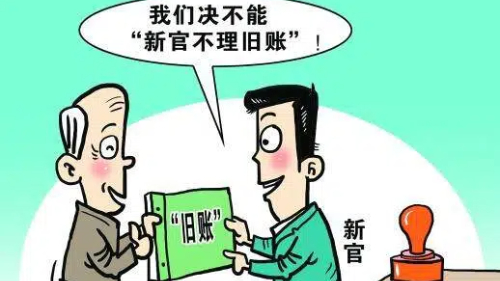
General Secretary Xi Jinping pointed out that political achievements "are reflected both in immediate results and in latent achievements that lay a foundation, build momentum, and benefit long term; they are reflected both in resolving current contradictions and in addressing historical legacy issues," emphasizing the need to "put an end to the practice of new officials ignoring old accounts to 'image projects' and 'vanity projects'." General Secretary Xi Jinping's important discourse has pointed the way for the vast number of Party members and cadres to devote themselves to people and be diligent and pragmatic in their work. The responsibility of governance and the commitment to the people must not be interrupted by the adjustment of cadres' positions. Only by properly handling accounts can the development of the cause be continued and the trust of the masses be won, which is the responsibility of governance that leading cadres should shoulder.
Benefiting the people is the fundamental purpose of governance. Old accounts are unfinished livelihood undertakings, linked to the urgent needs and concerns of thousands of households, and to bottlenecks and difficulties in enterprise development.This "avoidance" mentality reflects an indifference to the safety and well-being of the masses.Settling old accounts is not only about clearing "historical debts" but also about restoring the public's reputation. We must put the interests of the people first treat old accounts as a list of livelihood issues, make every effort to solve the people's problems, and truly be accountable to history and the people.
The reason why some Party members and cadres are reluctant to address old problems is that they have a skewed understanding of relationship between visible and invisible achievements, and old problems and new contributions. They believe that addressing old problems is "thankless work" and that "the credit goes to predecessors." In fact visible and invisible achievements, and old problems and new contributions, have never been separate. The process of solving old problems is also a process of investigation and research, through which one can the actual situation, grasp public opinion, see through surface contradictions to grasp the essence of problems, and find the key factors restricting development. Only by identifying shortcomings and weaknesses can one adapt to local and implement policies according to the situation, laying the foundation for forging a new path of development and establishing new contributions. Addressing old problems is not only about solving historical issues, but about clearing obstacles for the cause and building momentum for development, which can leave long-term "dividends" for future development. Party members and cadres should take over the baton with mindset of "success does not necessarily depend on me," and solve tough problems with the responsibility of "success must involve me," breaking the deadlock and establishing new contributions by tackling "hard," laying a foundation for future generations, and accumulating strength for future development.
The difficulty in solving old problems lies in their complex causes and intertwined contradictions. Relying solely on individual can easily lead to a situation of "willing but unable." To make new officials address old problems, efforts must be made to improve relevant systems and strengthen their implementation, turning the of old problems from an "optional question" into a "compulsory question." In recent years, many places have made beneficial explorations in this regard: establishing a rigid constraint mechanism for upon leaving office, turning "verbal handovers" into "account handovers"; promoting the normalization and listing of historical issues to eliminate the mindset of lazy governance; and incorporating the resolution historical issues into the performance evaluation system to establish a closed-loop of responsibility. These institutional practices both force current officials to follow rules and maintain bottom lines, and make successors clear their responsibilities. Through a "combination punch" of rigid constraints and positive incentives, a good atmosphere for work and entrepreneurship is formed, where "predecessors plant trees and continue to protect them." We need to further improve the full-chain mechanism of exit audits, responsibility handovers, and lifelong accountability. On the one hand, we should take tough against "officials who do nothing" and "passing the buck"; on the other hand, we should improve incentive mechanisms to support and encourage Party members and cadres who dare to tacklehard bones," allowing practical workers to stand out.
Politics values consistency, and governance requires regularity. A good blueprint can only become a beautiful reality if it is pursued to the end completed well. Party members and cadres should take a higher political stance, integrate their individual actions into the overall development of the Party and the country's cause, and continue working baton by like a relay race. With an unswerving posture, a sense of responsibility that says "if not me, then who," and persistent practical work, they should transform theproblem list" into the "happiness bill" of the masses, and deliver an excellent answer sheet of their performance of duties. (Outlook New Era)
Special statement: if the pictures and texts reproduced or quoted on this site infringe your legitimate rights and interests, please contact this site, and this site will correct and delete them in time. For copyright issues and website cooperation, please contact through outlook new era email:lwxsd@liaowanghn.com
 Recommended Reading Change it











Submission mailbox:lwxsd@liaowanghn.com Tel:020-817896455
粤ICP备19140089号-4 Copyright © 2019 by www.outlooknewera.com.cn all rights reserved
>