Interpreting the Central Plains Civilization in the Field Classroom
2026-06-18
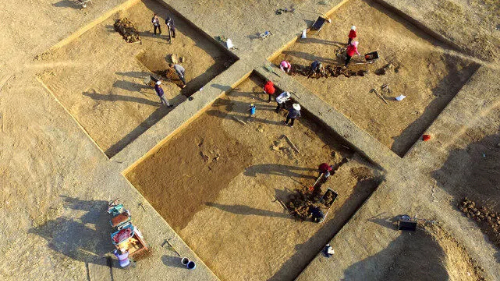
Traveling westward from Zhengzhou, from the city to the outskirts to Guangwu Town in Xingyang, one gradually sees the stretching of Mangling ravines and the spreading of the Yellow River floodplain. On a plateau sandwiched between two rivers, the ruins of Nancheng lie quietly in the morning sun. Dozens of wounds that explore the earth are like the eyes opened by history. Outside the exploration area, yellow soil pervades, inside the exploration area, there are echoes of history. However, what connects the middle line is a group of post-00s "archaeologists" in front of us - they are undergraduate students in the Archaeology Department of Zhengzhou University, using archaeological sites as scrolls and hand shovels and brushes as pens, interpreting the ancient civilization in field classes.
Henan has 16 major archaeological sites, ranking first in the country. Someone joked that with just one shovel, you might come across the Lijiagou culture from 10000 years ago, the Peiligang culture from 8000 years ago, or the Yangshao painted pottery from 5300 years ago.
The field is the best classroom. Walking on this land, it's hard not to feel a sense of awe: beneath every layer of loess lies an era, "said Han Guohe, Chief Professor of Archaeology at Zhengzhou University. This year marks the 50th anniversary of the Archaeology Department at Zhengzhou University, and recently, the Archaeology Department was awarded the National Worker Pioneer Award." As one of the earliest established archaeology disciplines in universities across the country, its establishment and development have always resonated with Zhengzhou Archaeology
Under the scorching sun, the students still crouched at the edge of the exploration, carefully trimming the soil layer with their hands. Everyone's movements were gentle, as light as wiping dust off an artwork. In the past year, this group of young people followed the Zhengzhou archaeological team to explore the site roads, clean up ash pit tombs, and discovered a total of 526 relics, covering the Longshan, Erlitou, Erligang cultures and the Qin and Han dynasties of the Eastern Zhou Dynasty.
Taking key archaeological projects as training grounds, teachers and students of the Archaeology Department learn skills, enhance their abilities, and cultivate their initial aspirations on the front line of the field. In April of this year, the Nancheng Site was named one of the top ten annual new discoveries in Henan archaeology. The Guanzhuang ruins from earlier years, after continuous excavation and exposure, have become known to the world as an ordinary village. In 2019, they were listed as a national key cultural relic protection unit. Going further back, the footprints of teachers and students are scattered throughout important sites such as Wangchenggang in Dengfeng and Xiaoshuangqiao in Zhengzhou. They also participated in the first excavation of the Peiligang site and proposed the naming of the Peiligang culture.
Saying goodbye to the soil and sandstorms in the wilderness, these excavated soil samples, bones, fragments of artifacts, and other samples were packaged and sent to the "Zhonghuayuan" Archaeological Laboratory at Zhengzhou University. This is the first batch of philosophy and social science laboratories in Henan's universities. The students put the femur specimens into the tray, and the 3D instrument captured the subtle morphology of the bones, and the data was recorded in the database. Behind the young figure is a collection of over ten thousand human bone specimens. They come from over a hundred sites in Henan, Shanxi, Shandong, Shaanxi, and other regions, spanning from the Neolithic period to the Ming and Qing dynasties. They are one of the richest collections of ancient human specimens in the Yellow River Basin in China.
Nowadays, archaeology is no longer just one acre and three fen of land in earlier years, but has become the forefront of interdisciplinary integration. The bronze arrowheads and bronze rod shaped utensils unearthed from the Xichuan Gouwan site have been identified through scientific and technological analysis as the earliest surviving bronze artifacts in the Yangtze River Basin; After carbon-14 dating, the remains of the Guanzhuang site have been confirmed to be the oldest known coin making workshop in the world... In more than 10 sub laboratories, including ancient DNA, environmental archaeology, and stable isotope analysis, related unearthed cultural relics such as the Peiligang site and the Zhengzhou Shangcheng site are also being studied in collaboration.
With the double wings of practice and scientific research, many outstanding students of the Department of Archaeology went out of the campus to devote themselves to the Central Plains: In Yin Xu in Anyang, He Yuling, the head of Anyang Workstation of the Archaeological Research Institute of the Chinese Academy of Social Sciences, spent more than 20 years exploring Dayi merchants; In the Longmen Grottoes in Luoyang, doctoral students such as Liu Yi conducted disease investigations and surveys among thousands of caves and niches, collecting materials for archaeological report writing... Over the past 50 years, renowned scholars such as Jing Sanlin, Liu Mingshu, Zhang Wenbin, and Liu Qingzhu have successively taught here, cultivating more than 1600 undergraduate, graduate, and doctoral talents.
Many people may ask: What is the purpose and significance of engaging in archaeology? In the academy's motto of "Sitting in the Wind and Standing in the Snow, Seeking Truth and Innovation", and on the banner of "The branch is built on the archaeological team" on the construction site, perhaps the answer can be found.
Leaving the ruins of Nancheng, the sunset is slanting. In the exploration, the young figure was still busy, and the rustling sound of the shovel touching the soil layer was like some kind of ancient whisper. These 'archaeologists' who connect ancient and modern times continue to write uninterrupted chapters of civilization. (Outlook New Era)
Edit:Luoyu Responsible editor:Wang Erdong
Source:people.cn
Special statement: if the pictures and texts reproduced or quoted on this site infringe your legitimate rights and interests, please contact this site, and this site will correct and delete them in time. For copyright issues and website cooperation, please contact through outlook new era email:lwxsd@liaowanghn.com

 Recommended Reading Change it