Waving hand dance is a traditional dance of the Tujia ethnic group, which is spread in the Youshui River and Wujiang River basins at the border of Hubei, Hunan, Chongqing, and Guizhou. It mainly expresses hunting, farming, military, and social life. The dance movements are rough and bold, with a unique style similar to disco, and have been listed as a representative project of China's national intangible cultural heritage. In the long historical process, hand waving dance has become a distinctive cultural symbol of the Tujia ethnic group, and it is still the most beloved fitness dance of the Tujia ethnic group today.
Why is hand waving dance popular in Tujia ethnic areas for over a thousand years and gaining popularity both domestically and internationally? How to take this ancient dance to a broader stage? Wang Song, Vice Dean of the School of Music and Dance at Hubei University for Nationalities, gave an interpretation in an interview.
Tujia girls dance hand waving dance on the street in Laifeng County, Hubei Province. (Image) Photo by Tang Jun
The summary of the interview transcript is as follows:
Reporter: As a unique expression of Tujia culture, how did the waving dance originate? Why has it been popular in Tujia ethnic areas for over a thousand years?
Wang Song: Qing Tongji's "Laifeng County Annals" reprinted the legend of "waving hand dance and Pushe tree" in the "Huguang Tongzhi" during the Five Dynasties period, vividly describing the scene of Tujia people dancing waving hand dance around Pushe tree more than a thousand years ago. This is the earliest record of Tujia waving hand dance in Laifeng, Hubei in historical books.
Hand waving dance is closely related to the production, life, religious beliefs, and war history of the Tujia ancestors. Its origins can be traced back to the following sources:
One is the worship of sacrificial rites and the worship of "white tigers". Legend has it that the ancestor revered by the Tujia ethnic group, "Linjun," transformed into a "white tiger" after his death. Therefore, the waving dance was originally a sacrificial dance to worship the White Tiger and comfort the ancestors, with movements such as sinking the center of gravity, swinging up and down, and bending the knees, imitating the posture of the White Tiger.
Another viewpoint suggests that the hand waving dance originated from military dance. In ancient times, the Ba people's army would dance a collective dance before or after their expedition to strengthen their military power and celebrate victory. This dance form gradually evolved into hand waving dance, and its rough and bold style was preserved.
The third is labor theory. The waving dance contains a large number of movements that simulate agricultural activities, such as "digging soil", "sowing seeds", "spinning cotton", "transplanting rice", etc. It is a direct manifestation of the Tujia ancestors' artistic expression of daily labor and a vivid example of "labor creates dance".
For the Tujia people, hand waving dance is not only entertainment, but also a "collective memory" of the entire ethnic group, deeply reflecting their spiritual beliefs, production labor, living habits, and emotional expression, integrated with life, and therefore extremely vigorous in vitality, popular for more than a thousand years.
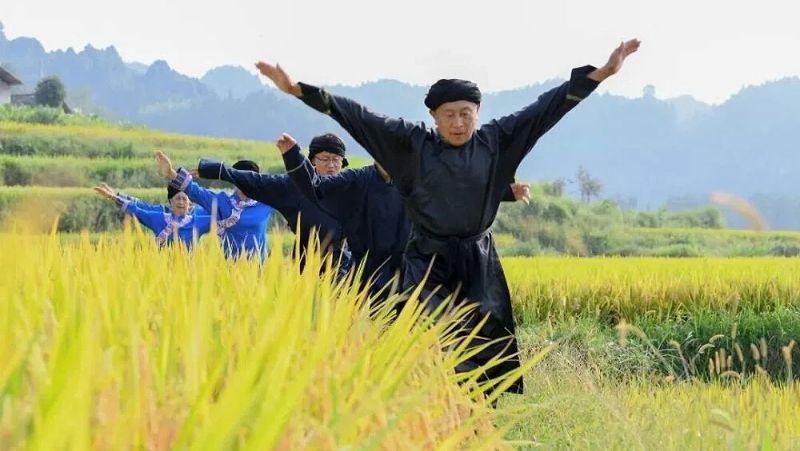
In Shemihu Village, Laifeng County, Hubei Province, Tujia people dance hand waving dances in the fields to celebrate a bountiful harvest. (Image) Photo by Tang Jun
Reporter: Why is it said that hand waving dance is similar to disco style? What are the characteristics of its movements?
Wang Song: Both swing dance and disco have two core characteristics - a strong sense of rhythm and free swinging of the body.
First, let's take a look at the rhythm. Disco has a strong and continuous rhythm as its soul, with dancers improvising and swaying freely to the rhythm of the drums. Waving dance controls the formation and movement changes through the rhythm of gongs and drums. The sound of gongs and drums accompanied the rhythmic breath of the crowd as they waved their hands and danced, creating a strong and vigorous, warm and solemn atmosphere.
Next is the swinging trait. Disco dancers twist various parts of their bodies to the rhythm of the music, expressing their individuality without restraint. The core movements of the swing dance are the swinging of the "same side hand" and the natural vibration of the body, presenting a unique and primitive beauty full of vitality through the rhythm of the body and the swinging of the hand.
Both hand waving dance and disco have strong group participation and infectiousness, which can quickly ignite the atmosphere and make people unable to help but want to join in, feel the rhythm and release passion in the collective carnival.
Reporter: What are the changes and innovations in the inheritance of hand waving dance? How to integrate this ancient dance art into modern life at present?
Wang Song: The inheritance of hand waving dance has undergone a transformation from "spontaneous folk" to "conscious protection". That is to say, the swing dance has shifted from a focus on sacrifice to a focus on cultural display, fitness and entertainment, and tourism experience, integrating square dance, fitness exercises, and modern stage performances. Its inheritance and development have shown vibrant vitality.
Taking Enshi Tujia and Miao Autonomous Prefecture in Hubei Province as an example, the local people have adapted the hand waving dance into a square dance suitable for public fitness, which not only retains the original ecological cultural charm of hand waving dance, but also endows it with modern fitness value, gradually evolving hand waving dance into a self entertaining folk dance, becoming a folk art form with dual characteristics of square self entertainment and theater performance.
With the development of the tourism industry, the cultural and tourism department has listed hand waving dance as a core experiential project, and has used media such as live streaming and short videos to bring this ancient dance closer to the public.
On April 20, 2024, Laifeng County held the "Cultural Memory Intangible Cultural Heritage Tour" characteristic intangible cultural heritage parade, where hand waving dance was performed on the same stage as Huangping Miao bench dance, Xuan'en play, Xianfeng bamboo horse and other ethnic dances, presenting a cultural feast for tourists. The local area also organically combines hand waving dance and disco to create 8 sets of movements, and the lively scene of thousands of people jumping and waving is popular all over the internet.
In April 2024, a phalanx composed of Tujia people performed a primitive hand waving dance on the streets of Laifeng County, Hubei Province. (Image) Photo by Tang Jun
Reporter: Hand waving dance has been performed multiple times in deep mountains and has been featured in cultural exchanges with countries and regions such as Australia and Thailand. In your opinion, why can this dance with "unfashionable" transcend national boundaries and move overseas audiences?
Wang Song: Since the mid-20th century, hand waving dance has received increasing attention and has shown its charm on domestic and international stages, performing in countries such as South Korea, Australia, France, and Poland multiple times. I think the charm of hand waving dance lies in the common emotional value of human beings contained in its "unfashionable".
As is well known, people's feelings of happiness and collective belonging are interconnected. The strong rhythm, exaggerated body movements, and joyful collective atmosphere of hand waving dance have a strong infectious power, which can convey the most primitive happiness and enthusiasm, making the audience emotionally infected and resonating.
In today's globalized world, people are increasingly eager to see authentic, unique, and unadorned cultural expressions. Hand waving dance is unique in traditional Chinese ethnic dance, with a strong local flavor and primitive vitality, which is the ultimate embodiment of this "authenticity" and satisfies the curiosity and longing of audiences at home and abroad for "cultural diversity" and "primitive" art. It also provides a completely different aesthetic sample for the world dance world, full of Eastern philosophy and mountain ethnic characteristics, bringing fresh artistic impact.
Reporter: Do you have any suggestions for promoting the swing dance to a broader overseas stage?
Wang Song: The waving dance symbolizes the power of the Tujia people to get close to nature, love labor, fear difficulties, live optimistically, and survive tenaciously, and has unique cultural exchange value. Therefore, we need to strengthen international exchanges and cultivate "cultural ambassadors" who not only understand dance but also are familiar with international cultural exchange rules, vividly explaining the history and cultural connotations of hand waving dance.
At the same time, we need to create exquisite works, achieve cross-border integration, and create a batch of stage art masterpieces that not only retain core genes, but also have modern and international expression methods, so that hand waving dance has more cultural sharing value in cross-cultural contexts.
To fully leverage the communication advantages of new media and flexibly utilize social platforms, various forms of hand waving dance works should be launched through short videos, documentaries, VR/AR immersive experiences, etc.
Interviewee Profile:
Wang Song, Vice Dean and Master's Supervisor of the School of Music and Dance at Hubei University for Nationalities, Chairman of Enshi Dancers Association, Director of Hubei Dancers Association, Member of China Dancers Association, and Master's Supervisor of Dance Major at Wuhan Sport University.
Engaged in long-term research on Tujia ethnic dance, the directed works have won national and provincial awards multiple times, and have been awarded the honorary title of "Outstanding Literary and Artistic Creator of Ethnic Minority Culture Government Award" by the Hubei Provincial People's Government. They have also been selected for the Hubei Provincial Federation of Literary and Art Circles' Young and Middle aged Excellent Literary and Artistic Talent Pool and the "Dictionary of Chinese Dance Aesthetic Education Masters". (Outlook New Era)

 Recommended Reading Change it