(Ba Min Qian Zi) "Knife" farming never stops, Fuzhou ancient rare craftsmen inherit cork painting
2025-07-07
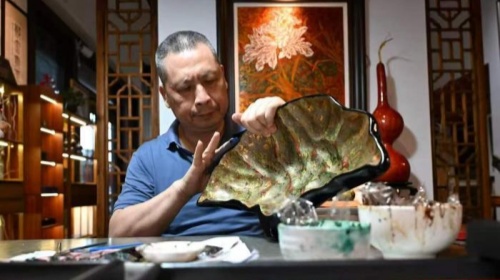
Chen Guoxian, the representative inheritor of the national intangible cultural heritage representative project Cork Painting, who is over seventy years old, is focusing on carving the texture of lychee trees, holding a thin piece of cork in his left hand and a carving knife in his right hand. Every day from 5 to 9 o'clock, he creates in his studio located in Fuzhou, where he has the most energy and inspiration. Recently, the reporter walked into Chen Guoxian's Cork Painting Skills Master Studio and saw dozens of cork painting works displayed, with landscapes such as mountains, rivers, pavilions, pavilions, flowers, and trees condensed into a square inch, showcasing the artistic conception of "hundreds of miles of mountains, all in one frame". Fuzhou Cork Painting has a history of over a hundred years and is known for its unique technique of "using knives instead of pens and using wood to paint". Through meticulous carving and clever composition, the scenery is made three-dimensional, known as the "silent poetry and three-dimensional painting". It is also known as one of the "three treasures" of Fuzhou's arts and crafts, along with Shoushan stone carving and bodice lacquerware. In 1953, Chen Guoxian was born into a traditional Chinese medicine family in Xiyuan Village, Xindian Town, Jin'an District, Fuzhou, the birthplace of cork painting. His family originally expected him to study medicine, but he became obsessed with cork painting. "The first time I met him, it felt particularly familiar, like a natural fate. After more than 50 years of deep cultivation in the field of cork painting, Chen Guoxian's studio is not only filled with finished products, but also stacked with thick creative sketches. Even the frames of his works are designed by himself. Yellow and red desert poplar trees, primitive architectural complexes, and unique ancient dwellings in Xinjiang... Recently, Chen Guoxian has just completed the framing of his new work "Kashgar Ancient City, Xinjiang". This artwork originated from his trip to Xinjiang: he used a camera to capture the local scenery and then incorporated it into his creative work. Learning photography has been very helpful to me, especially in the use of light and shadow. ”He pointed to the work and introduced that by using the difference in the depth of cork layers between domestically produced and imported oak trees, a far and near light and shadow effect is created; The yellow and red desert poplar trees in the picture represent his innovative attempt to combine oil painting with cork after studying oil painting in Putian. Faced with the limitation of single color in cork paintings, Chen Guoxian constantly breaks through. I want my works to be closer to reality and more vibrant, "he said, hoping to integrate cork painting with more art forms. Because of innovation and continuous development, Chen Guoxian's cork painting "A New Blessed State in Haixi" won the gold medal of the "Hundred Flowers Award Award" for Chinese arts and crafts in 2011. Afterwards, "Yongding Tulou Scenery", "Summer Palace Scenery", "Suzhou Tiger Hill Scenery", and "Chinese Dream" won the gold medal of this award for four consecutive years. I only do one thing in my life, which is to create cork paintings. I can work until the age of 80 to innovate and inherit cork painting. ”Despite being in his seventies, Chen Guoxian still insists on creating at least one large-scale work every year. "I plan to create a series of works around 56 ethnic groups in China, and in the future, I also want to open a private museum to let more people know about cork painting." In Chen Guoxian's studio, 18-year-old Jiang Hanwei is focusing on learning art. When it comes to inheritance, Chen Guoxian sighed: "Among the apprentices he has taught, some have become backbone, some have learned skills while studying, and some have given up halfway. The key to inheriting old skills lies in whether young people can concentrate and persist." In the 1980s, cork painting was one of the crafts with the highest foreign trade export rate in Fujian Province. However, with the gradual decline of the cork painting industry in Fuzhou, the number of local employees has sharply decreased, with less than a hundred people, and it was once known as the "memory of Fuzhou that is about to disappear". To cope with the current situation of a shortage of experienced artists, Chen Guoxian has widely recruited disciples, promoted cork paintings on online platforms, and taught at Fuzhou Software Vocational and Technical College, hoping to revitalize cork paintings. Young people are willing to inherit, only then can old skills be continued
Edit:Momo Responsible editor:Chen zhaozhao
Source:
Special statement: if the pictures and texts reproduced or quoted on this site infringe your legitimate rights and interests, please contact this site, and this site will correct and delete them in time. For copyright issues and website cooperation, please contact through outlook new era email:lwxsd@liaowanghn.com
 Recommended Reading Change it

















 Home
Home

