The patriotism on the contemporary stage of drama
2025-12-04
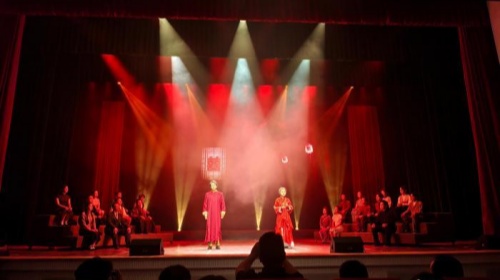
On the contemporary stage of drama, the expression of patriotism not only depends on the choice of subject matter, but also on how creators use unique creative techniques to transform it into an artistic experience that the audience can feel and resonate with. Whether it is traditional cultural themes, revolutionary historical themes, or realistic themes, creators use different creative paths and stage languages to constantly expand the depth and breadth of expressing patriotism, telling unique stories of our era. "National Tide Fever" awakens cultural memory and national identity. In recent years, "National Tide Fever" has emerged in the field of culture and art. This upsurge is also reflected in stage art works. Chinese excellent traditional cultural themes are increasing year by year. Among them, the most famous and typical is the dance drama The Journey of a Legendary Landscape Painting, which is a contemporary dance drama co directed by Zhou Liya and Han Zhen, the "twin stars" in the dance world, and jointly produced by the Palace Museum, China Oriental Performing Arts Group Co., Ltd., and other institutions. It chooses the famous painting of the Song Dynasty, "A Thousand Miles River and Mountain Map", as the object of expression, and produces an extremely beautiful romantic story about the motherland, a generation of talents, and famous paintings expressed by limbs. After being spread on the Spring Festival Gala stage, the play became popular throughout the country and captured countless audiences. Those who watched the play fell in love with traditional Chinese painting and the scenery of their motherland, and sincerely felt a strong sense of national pride. In general, we often think that only revolutionary history and other related themes can express the feelings of family and country. However, a series of excellent Chinese traditional cultural works represented by The Journey of a Legendary Landscape Painting on the stage today show us how to convey the feelings of family and country to the audience silently with unique creativity, exquisite production and vivid performance. In these works, the expression of patriotism is often not directly presented through grand narratives, but through the creative translation of cultural symbols and the creation of aesthetic imagery, triggering the emotional identification of the audience. In the excellent works that have emerged today, techniques such as "symbolic symbolism" and "dialogue between ancient and modern times" are often used to transform historical figures, intangible cultural heritage techniques, literary classics, and other elements beyond mere symbolic symbols into vivid images that carry national memory and national consciousness. There are a lot of symbolic expressions in the dance drama The Journey of a Legendary Landscape Painting, which makes the traditional culture live. Taking 'A Thousand Miles of Rivers and Mountains' as the core of stage visual and theatrical spirit, the unique dance vocabulary is used to contextualize and ritualize intangible cultural heritage crafts such as weaving and ink making. The creator takes "green" as the core visual symbol and emotional carrier, elevating the originally static painting process to love for the mountains and rivers of the motherland and respect for traditional culture. This advanced technique of "image transformation" transforms intangible cultural heritage from a static display in museums to a lively and vivid cultural heritage that can be danced and felt, effectively arousing the audience's recognition and conviction of the inheritance of civilization. With the spread of the Spring Festival Gala stage, the image of "green" has become popular culture, appearing in every aspect of our daily lives. It can even be said that the image of "green" has gradually transformed into a new cultural symbol representing the Chinese nation. The stage play "Spring Dawn on the Su Causeway" staged last year tells the story of the popular cultural IP "Su Dongpo" in recent years. Although it also portrays a great literary figure, the play takes a unique approach and achieves an organic connection between ancient and modern spirits through "contemporary perspective intervention". The creators boldly introduced modern vocabulary such as "thermos cups" and "civil servants", combined with the traditional opera performance method of "jumping in and out", cleverly narrowing the psychological distance between historical figures and contemporary audiences. In this drama, Su Dongpo not only has the tenderness of "rivers overflowing from the cup of a river", but also closely blends his personal emotions with his concern for his family and country. When he uses the "Shi" in his name to make the bold statement "The Great Song Dynasty is a carriage, I would like to be the carriage's Che Shi, let the Great Song Dynasty see further", the traditional literati's sense of family and country responsibility is endowed with a lamentable temperature for contemporary audiences. This "estrangement" treatment has allowed the patriotic sentiment of the great literary figure Su Dongpo, who was concerned about the country and the people, to enter the emotional world of modern people from historical texts, naturally prompting the audience to reflect on "what Chinese people are, and what kind of life and responsibility Chinese people should have". The success of these works lies in the fact that the creators did not rigidly express their values, but instead used exquisite artistic techniques to make the overall emotional trend of the drama intoxicated with admiration for the culture and history of the motherland, thus making the audience's emotions also belong to the recognition of national culture. In this era of rediscovering and cherishing the value of China's excellent traditional culture, the deep excavation and creative transformation of the essence of traditional culture have quietly awakened the audience's cultural memory and family identity. Revolutionary narrative builds a new way of dialogue with history. Stage works with revolutionary historical themes are an important carrier for expressing patriotism. To create something new and unique, it is not easy to move people's hearts through exciting story cores and well run stage innovation, and avoid falling into narrative traps and emotional preaching. Looking at the outstanding works in recent years, many of them actively use innovative techniques such as "multiple perspectives", "temporal and spatial interweaving", and "media experiments" to give revolutionary narratives contemporary aesthetic tension and emotional impact. These works explore new ways of expressing patriotism in both content and form, providing audiences with new avenues for dialogue with history. The Chinese National Theatre's "Iron Stream Eastward" set a narrative perspective of "intergenerational dialogue and identity exploration", gradually uncovering the historical events of the New Fourth Army in 1941 through the process of Sun Tzu exploring the true identity of his elderly grandfather in his early years. This' retrospective narrative 'satisfies the audience's sense of suspense as they follow the plot to solve puzzles layer by layer, providing an effective path for the audience, especially young viewers, to enter history. The "imperfect hero" image portrayed in the drama, who grows from ordinary people to revolutionary soldiers, has become a bridge for contemporary youth to understand revolutionary history. When the telegram "This prosperous era is as you wish" came through the radio at the end of the drama, the ideals of revolutionaries and the emotions of contemporary people reached a profound emotional and spiritual resonance in the theater space. The documentary drama "Literature and Art in the Anti Japanese War" explores a new possibility of "documentary drama and chronological narrative". The whole play is arranged in chronological order to sort out the creations of Chinese literary and artistic masters during the Anti Japanese War. This seemingly tedious narrative style has become exciting and novel due to the bold and extensive introduction of visual installations by the creators on stage. At the same time, actors on stage also have multiple identity transitions, sometimes as third person narrators, and sometimes as literary figures they speak of. Multiple perspectives, combined with the overlapping light and shadow on stage, release infinite brilliance in a new form of theatrical performance art. The presentation of the entire drama's content is even more impressive to the audience, as summarized by writer Ba Jin: "Literature and art should not only promote the improvement of individual human spirit, but also promote the unity of human groups." "Chord songs continue to sing about mountains and rivers," which are the homeland in crisis. Drama summons contemporary audiences to recognize their patriotism in this way. When the language and works of literary and artistic figures during the Anti Japanese War are reinterpreted, literature is no longer static background information, but becomes a "spiritual testimony" that transcends time and space, greatly enhancing the authenticity and speculative nature of patriotism narrative. Looking at the innovative expression of revolutionary themed dramas on the contemporary stage, several common creative characteristics can be summarized: firstly, to showcase the collective image of revolutionary soldiers and the people, consciously express the "people's view of history", and root the righteousness of the country in the struggle and sacrifice of ordinary people; Secondly, in terms of plot setting, the perspective of contemporary youth is often introduced, and the emotional journey of revolutionary martyrs is reinterpreted through a narrative framework that intertwines time and space or an unfamiliar observation perspective; Finally, the director and creator have a considerable sense of media consciousness, adept at using new stage installations and multimedia forms to create stunning audio-visual effects, allowing the audience to have a more authentic perception of revolutionary history. The application of these innovative techniques ensures that the patriotism in revolutionary historical drama works will not become simple historical preaching, but rather become a spiritual bridge connecting revolutionary history and contemporary society in the hearts of the audience. Realistic themes emerge from the ordinary with extraordinary value coordinates. Realistic works occupy an important position on the contemporary stage, with a wide range of content and rich emotions expressed, often attracting contemporary audiences the most. In such works, if the audience also feels a sense of patriotism, it must be that the creator cleverly integrates their own patriotism into the texture of contemporary life. Instead of slogan and conceptualization, it is often a meticulous and thoughtful stage portrayal that combines micro narrative, symbolic purification, and spiritual tracing strategies, allowing grand narratives to flow naturally in the details of life. The play "Warm Taste" by the China Coal Mine Art Troupe achieves a poetic sublimation of geographical imagery in the story of rural revitalization. In this story, the rural scenery and customs convey a sense of nostalgia that accompanies rural development. When the plot reaches its ideal ending, the protagonist expresses his emotions at the end of the play: "An apple tree grows for 40 years, a person lives for 80 years, a cave dwelling lasts for over a hundred years, but the Yellow River water has flowed here for thousands of years. Just as the Yellow River water rises from the sky, you cannot forget your own bloodline and the power of life. At this moment, the Yellow River is no longer a simple geographical concept, but has become a poetic symbol of the unity of family and country. This kind of "imagery finishing touch" has given the theme of rural revitalization a profound historical and cultural depth, and the patriotism has inadvertently overflowed in this sentiment. The "Ruge" by Wuhan People's Art Theatre uses the city as a metaphor for the role and era. The work focuses on ordinary people in the city, with the main theme of Hu Xiaoshan, a young man who drifted north, returning to his hometown Wuhan. Through his reunion with family and friends, he re examines his growth process, family relationships, friendship, and love, completing a spiritual return. Against the backdrop of the 40 year development of Wuhan, the human fireworks and the passage of time in the plot are actually metaphors for the spiritual journey that Chinese people have experienced in the process of national modernization. This narrative style that superimposes personal destiny with urban development and the process of national modernization allows patriotism to sink into the narrative context of the great changes of the times, and quietly flow in the hearts of the audience. The expression of patriotism in realistic drama works increasingly reveals a "spiritual origin" strategy: they either originate from the traditional concept of "the rise and fall of the world is the responsibility of every individual" or inherit the core of the "people's view of history" in modern revolution. From the patriotism contained in the drama, we can see the continuation of tradition and hear the echoes of history. These works inadvertently reveal an extraordinary value coordinate in the realistic life scene of peaceful times and in the conflicts of ordinary life, quietly surpassing the ordinary trivialities in human fireworks, and making ordinary people unexpectedly radiate a "heroic spirit" in their daily lives, which comes from the profound cultural accumulation of their country. Contemporary drama creators are using a strong cultural consciousness and rich and exquisite creative techniques to build an aesthetic bridge between tradition and modernity, history and the present, making patriotism not only a narrative theme, but also an artistic force that questions the hearts of the audience. It is in such creation that drama achieves a sublimation from "conveying emotions" to "shaping emotions", building the spiritual home of our era on stage and continuously providing spiritual nourishment for the audience. (New Society)
Edit:ana Responsible editor:zhang lin
Source:gmw.cn
Special statement: if the pictures and texts reproduced or quoted on this site infringe your legitimate rights and interests, please contact this site, and this site will correct and delete them in time. For copyright issues and website cooperation, please contact through outlook new era email:lwxsd@liaowanghn.com
 Recommended Reading Change it











 Home
Home

