Glimpsing the big era behind the 'child'
2026-05-12
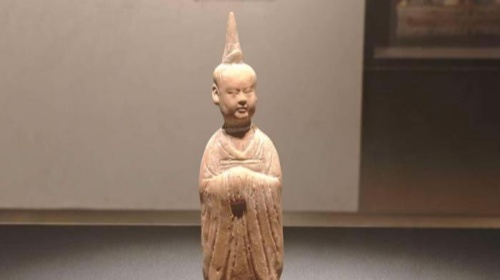
On the just passed May Day, the exhibition "Li Jingxun and Her Era" at the National Museum of China was very popular. Since its launch in April, this exhibition has attracted a lot of attention, and its exquisite cultural relics and creative works have continued to generate heated discussions online. This exhibition is a high-quality exhibition independently planned by the National Museum of China, relying on its collection resources and leveraging the advantages of its cultural heritage team. For the first time, it systematically displays more than 240 pieces (sets) of related cultural relics from its collection, as well as more than 150 pieces (sets) of cultural relics treasures from more than 10 archaeological cultural heritage units in Shaanxi, Shanxi, Henan, Ningxia, Tianjin and other regions. The exhibition takes the unearthed cultural relics from Li Jingxun's tomb as a starting point, and through four parts: "Zhilan Tianting," "Qingbai Jiaohui," "Silk Road Liuguang," and "Qu Yuning Yi," it outlines a magnificent scene of the political system, economic exchanges, social culture, and ethnic integration of the Sui Dynasty. Gold and jade shine brightly, reflecting countless dotes. Who is Li Jingxun? She was born into a noble family and grew up in a deep palace. Her name is not recorded in historical records, but became known through archaeological discoveries. In 1957, the Institute of Archaeology of the Chinese Academy of Sciences (now the Institute of Archaeology of the Chinese Academy of Social Sciences) excavated a tomb of the Sui Dynasty in Liangjiazhuang, west of Xi'an City, Shaanxi Province, bringing Li Jingxun, a dusty name for thousands of years, into public view. The epitaph clearly outlines her identity and family background: Li Jingxun, also known as Xiaozi, was born in Chengji, Longxi (now Qin'an, Gansu). She was the fourth daughter of Li Min, a left Guanglu official, and passed away at the age of only 9. Her great grandfather was Li Xian, the great general of the Northern Zhou cavalry, her maternal grandfather was Emperor Xuan of Northern Zhou, Yuwen Yun, and her maternal grandmother Yang Lihua was not only the Empress of Northern Zhou, but also the eldest daughter of Emperor Wen of Sui, Yang Jian, and Empress Dugu Jialuo. Li Jingxun was raised by his maternal grandmother from a young age and spent a brilliant yet brief childhood in the midst of countless dotes. In the fourth year of the Daye reign of the Sui Dynasty (608 AD), she followed her grandmother to Fenyuan Palace (located in present-day Ningwu, Shanxi) to escape the summer heat and died of illness. She was later buried in Xiuxiang Fang in Daxing City, the capital of the Sui Dynasty. The tomb of Li Jingxun is the most well preserved and highest grade tomb of the Sui Dynasty discovered so far, with over 230 cultural relics unearthed, including stone coffins, epitaphs, pottery figurines, porcelain, gold and silverware, glassware, etc., providing important evidence for studying the history, culture, and daily life of the Sui Dynasty. This exhibition will bring together the cultural relics of Li Jingxun's tomb, which are distributed in multiple exhibition halls of the National Museum, and showcase more than 50 recently restored cultural relics. Upon entering the exhibition hall, the first thing that catches the eye is the "star cultural relic" - the "noisy moth golden hairpin": on a lush flower cluster composed of six petal shaped golden flowers, triangular golden leaves, etc., stands a golden moth spreading its wings and ready to fly, presenting a lively atmosphere of "noisy moth fluttering against flowers"; Pearls and precious stones are embedded in the flower bud, and a net is woven with gold wire, with small beads hanging on top for decoration; The wings and body of moths are both made of gold wire and embedded with pearls. It can be imagined that when the wearer walks, the golden hairpin sways gracefully, the flower branches tremble slightly, and the moth wings flutter vividly. What a charming scene it is. Zhao Yuliang, deputy research curator and curator of the National Museum of China, introduced that the production technology of gold and silver hairpins in the Sui Dynasty was advanced, and the moth infested golden hairpin can be regarded as a masterpiece of hair accessories during this period, containing the beautiful meaning of "many children, many blessings, and endless life". When this cultural relic was unearthed, it was deformed and scattered. It took several months for the national museum and cultural preservation personnel to repair it, restoring its charm from more than 1400 years ago. This is its first appearance after restoration, attracting many viewers to concentrate and appreciate. It is worth noting that this gold headpiece looks like a crown, but it is actually a hairpin. In the display cabinet in the corner of the wall, there are also three silver hairpin foot fragments on display. The hairpin legs can be inserted into the flat tube in the middle of the back of the golden hairpin for easy wearing. The gold necklace inlaid with pearls and precious stones is also a highly anticipated treasure, which was unearthed on the neck of Li Jingxun. It is made up of 28 gold spherical chain beads embedded with pearls, with a bright bloodstone set on a large round gold ornament in the center at the bottom of the necklace, surrounded by pearls, and a heart-shaped gold ornament hanging below, embedded with a large blue gemstone. Under the light, the red and blue sapphires complement each other with pearls and gold, creating an unparalleled brilliance. Zhao Yuliang introduced that the production process and decorative style of this necklace have integrated the characteristics of Central Asia, West Asia, and other regions, and are the product of multicultural exchange and mutual learning. Small and exquisite daily necessities such as gold inlaid white jade cups, high footed gold cups, silver chopsticks, silver daggers, as well as jewelry such as gold rings, silver nail covers, jade hairpins, crystal hairpins, etc. were unearthed from Li Jingxun's tomb. There are also miniature silver boxes, silver stoves, silver plates, etc., all of which express the elders' love for their children. Linlang beautiful utensils, showcasing exquisite craftsmanship. The Sui Dynasty was an important period of transformation in the development history of Chinese ceramics, laying the foundation for the porcelain production pattern of "southern blue and northern white" in the Tang and Five Dynasties. Seventeen pieces of porcelain were unearthed from the tomb of Li Jingxun, divided into two types: celadon and white porcelain, including teapots, jars, bottles, and other vessel types. They are precious Sui Dynasty dating standard vessels. The double layered serrated lid jar with blue glaze has a greenish gray glaze color and ice cracks. There is a triangular serrated decoration on the shoulder and abdomen, with the tip pointing outwards. The jar button is a combination of two lotus leaves and two lotus pods, which is highly ingenious. The seven glazed jars in the same display cabinet are made up of seven porcelain jars of the same size glued together with porcelain glaze. One jar is centered and six jars surround it, looking like blooming flowers. A beautifully decorated blue glazed eight series jar, jokingly referred to as Li Jingxun's "snack jar", was unearthed containing charred walnuts. The blue glazed hollow smoked cage glaze has a warm color and a simple shape; Next to it is a display of figurines of maidservants holding smoking cages from the Sui Dynasty unearthed in Anyang, Henan, vividly depicting the use of smoking cages. The emergence of white porcelain holds significant importance in the history of ceramics. From the late Northern Dynasties to the Sui Dynasty, the firing technology of white porcelain matured. Due to the difficulty of firing, white porcelain from the Sui Dynasty had obvious luxury attributes and had very few surviving quantities. Several exquisite white porcelain pieces were buried with Li Jingxun's tomb, indicating its high specifications. The white glazed chicken head pot is coated with white glaze throughout, with fine ice cracks on the surface. On one side of the shoulder, there is a chicken head with a high crown, round eyes, and a crowing mouth. On the other side, there is a straight curved neck shaped dragon handle, with the dragon mouth connected to the edge of the pot mouth. The overall shape is straight and beautiful, with graceful lines. Some scholars believe that this type of artifact imitates the gold and silver artifacts introduced from the Western Regions. The comparison exhibition of the Sui Dynasty white glazed dragon handle vase in the collections of Tianjin Museum and National Museum deepens the audience's understanding of such artifacts, with one being a handed down cultural relic and the other being an unearthed cultural relic. Chuanping is a special type of porcelain bottle with two connected bellies, sharing one neck and one mouth. A dragon shaped handle is molded on each side of the shoulder, and the dragon head is inserted into the bottle mouth. The Tibetan vase of the Tianbo Institute is a cultural relic that is prohibited from being exhibited abroad. The bottom of the vase is inscribed with the words "This transmission vase has been merged", meaning that two vases have been merged. The double series flat pot with white glazed animal face pattern is also quite eye-catching. The pot has a flat body with identical patterns on both sides, with a beast face in the middle and a honeysuckle leaf on each side of the mouth, surrounded by a bead. Next to it is a display of a Northern Qi yellow glazed double series flat pot unearthed from the Fan Cui Tomb in Anyang, with Hu people's music and dance scenes engraved on both sides of the pot belly. Zhao Yuliang introduced that this flat pot with exotic colors is based on artifacts from West Asia, Europe, or the Mediterranean coast. Some scholars also believe that it directly imitates the metal flat pot of Sassanid Persia, and its embossed pattern is similar to the hammer and bow pattern on Sassanid gold and silver utensils. In the glassware exhibition area, carefully designed booths and lighting showcase the crystal clear transparency of glass to the extreme. Glass was one of the extremely precious materials at that time, with a value comparable to gold and gemstones. A total of 24 glassware were unearthed from Li Jingxun's tomb, among which green glass covered jars and green glass flat bottles were listed as cultural relics prohibited from being exhibited abroad. They reflect two different glass crafts of the Sui Dynasty: the lid jar is a typical Chinese artifact, made of traditional Chinese high lead glass with cold grinding marks on the surface; The flat bottle is made of blown soda lime glass, with a texture and craftsmanship similar to West Asian glass, and a shape similar to the Western style flat pot. The integration and coexistence of local craftsmanship and foreign technology is a vivid portrayal of the openness and inclusiveness of the Sui Dynasty. Observing the big picture from a small perspective and showcasing the changes of the times is a popular way of historical research nowadays. The Dugu, Yuwen, Yang, and Li families behind Li Jingxun propelled the wheels of historical development from Northern Zhou to Sui and Tang dynasties. The final part of the exhibition takes archaeological discoveries as clues, gradually unfolding Li Jingxun's family network and presenting a magnificent picture of the era. Li Jingxun's great grandfather, Li Xian, was a famous general during the Northern Wei to Northern Zhou period. He served as the general manager of Hezhou (now Linxia, Gansu) and Taozhou (now Lintan, Gansu), controlling the northwest fortress. The gilded gold and silver teapot unearthed from the tomb of Li Xian and his wife is a well-known national treasure level cultural relic. The handle of the pot is cast with a high nose and deep eyes portrait, and the pot body is decorated with a pearl pattern. The belly is hammered with ancient Greek mythological story patterns, witnessing the integration of diverse civilizations on the Silk Road. Li Jingxun's great grandmother (mother of Yang Lihua) was Empress Dowager Dugu Jialuo of the Sui Dynasty, while Dugu Jialuo's father Dugu Xin was a famous general during the Western Wei and Northern Zhou dynasties and one of the Eight Pillars of State. His eldest daughter is Empress Mingjing of Northern Zhou, his fourth daughter is the mother of Tang Gaozu Li Yuan (posthumously honored as Empress Yuanzhen), and his seventh daughter is Dugu Jialuo. The historical books of the Tang Dynasty state that "the Zhou, Sui, and royal families were all relatives of the same clan for three generations, which has never existed since ancient times". In the exhibition, cultural relics unearthed from the tombs of Dugu Xin, his eldest son Dugu Luo, and his fourth son Dugu Cang can be seen, telling the story of this prominent family. This set of copper belt tools was unearthed from the tomb of Emperor Wu of Northern Zhou, Yuwen Yong, who was the father of Li Jingxun's maternal grandfather Yuwen Yun. ”Zhao Yuliang said that these major families gathered various forces through marriage alliances and alliances, promoting the stability and integration of the northern regime, and laying a solid foundation for Emperor Wen of Sui, Yang Jian, to unify the north and south. The largest box shaped stone coffin from Northern Wei to Tang Dynasty was unearthed from the Sui tomb in Shucun, Tongguan, Shaanxi. All walls from the tomb passage to the tomb chamber are painted with murals, and experts speculate that the tomb owner is Yang Yong, the deposed crown prince of the Sui Dynasty. The exhibition hall has restored and displayed this stone coffin, showcasing its large size and rich and exquisite line carved patterns, highlighting the identity of the tomb owner. The Sui Dynasty, which lasted less than 40 years, holds a unique significance in Chinese history. It carries forward the past and opens up the future, integrating North and South cultures, absorbing foreign civilizations, and laying the foundation for the prosperity of the Tang Dynasty. The era in which Li Jingxun lived was the most glorious period of the Sui Dynasty: the shimmering waves on the Grand Canal, the melodious camel bells on the Silk Road, and the convergence of various cultures. At the end of the exhibition, pottery figurines from the Sui Dynasty unearthed from various places were displayed, including figurines of laborers, musicians and dancers, maidservants, literati, warriors, etc. They are the most authentic silhouettes of this era. Leaving the exhibition hall, the cultural and creative counter was particularly lively. Liao Fei, the person in charge of Guobo (Beijing) Cultural Industry Development Co., Ltd., introduced that there are more than 70 cultural and creative products developed around this exhibition, among which two moth making golden hairpin refrigerator stickers are particularly popular - the wooden version can light up the "gem" on the hairpin by tapping lightly; The metal version "one item, three uses" not only allows you to experience "AR hairpin wearing", but also can be paired with a hair comb to wear on your head. The golden moth can also be disassembled and worn as a badge. In the research and development process, the first thing we need to solve is to make the golden flowers move and better restore the visual effect of cultural relics, "said Liao Fei. The wind and smoke of history have gone far away. A thousand years later, in museums, modern and ancient people can engage in conversations that transcend time and space, feel the sincere and profound love of licking a calf, and appreciate the timeless charm of Chinese civilization. (Looking into the New Era)
Edit:Luoyu Responsible editor:Jiajia
Source:people.cn
Special statement: if the pictures and texts reproduced or quoted on this site infringe your legitimate rights and interests, please contact this site, and this site will correct and delete them in time. For copyright issues and website cooperation, please contact through outlook new era email:lwxsd@liaowanghn.com
 Recommended Reading Change it



 Home
Home

