Smart agriculture makes the fields' vibrant and colorful '
2026-07-02
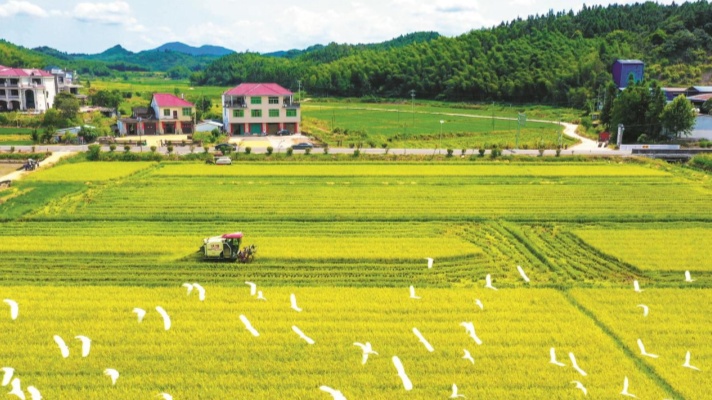
Hubei has invested over 30000 sets of intelligent agricultural machinery and equipment, using the Beidou Smart Agriculture Management and Service Platform as a starting point, to vigorously develop smart agriculture; Guangdong has utilized the integrated technology of "artificial intelligence+sky ground network" to achieve intelligent management of thousands of acres of rice fields... Currently, as an important direction for the development of modern agriculture in China, smart agriculture is not only a "smart engine" to ensure food security and empower stable production and supply, but also to make field operations orderly and information visible, presenting a vivid digital and intelligent scene.
In recent years, the development of smart agriculture in China has achieved remarkable results. The No. 1 central document has emphasized promoting the development of smart agriculture and strengthening the construction of digital infrastructure for many consecutive years. The National Smart Agriculture Action Plan (2024-2028) issued by the Ministry of Agriculture and Rural Affairs clearly proposes to promote the construction of smart agriculture demonstration areas, agricultural big data platforms and the promotion of smart equipment. Data shows that by 2025, the contribution rate of agricultural scientific and technological progress in China will exceed 64%, the comprehensive mechanization rate of crop cultivation and harvesting will reach 76.7%, the number of agricultural unmanned aerial vehicles will exceed 300000, and the annual operating area will exceed 460 million mu. A number of independent achievements such as the first pear multi arm picking robot and Shennong Model 3.0 have been successively launched in China. Each region also adapts to local conditions and actively innovates the development model of smart agriculture. For example, Yinchuan City has established a field smart farm planting model that utilizes device perception data, data-driven decision-making, and intelligent equipment execution, achieving centimeter level precision in tillage and leveling; The fish and vegetable symbiotic digital factory in Liangping, Chongqing achieves real-time regulation of water quality, temperature, and nutrients through intelligent control.
However, the current low degree of autonomy in core technology and the complex and diverse field application scenarios are intertwined, leading to increasing industry differentiation. In some remote areas, the stability of agricultural IoT devices is insufficient, data collection accuracy is not high, and the shortcomings of anti-interference and weather resistance are highlighted. In addition, key components such as high-end sensors, dedicated chips, and intelligent algorithms have a high degree of external dependence, while the underlying data standards and interface protocols are difficult to unify, and the problem of data silos and system fragmentation continues to accumulate. These have become prominent contradictions that constrain the large-scale implementation of smart agriculture. In the long run, the technological innovation capability, achievement transformation efficiency, data integration level, and intelligent equipment linkage capability of smart agriculture still need to be continuously improved.
Accurate perception in the field enables smart agriculture to see clearly. Accurate perception is the foundation of smart agriculture and a prerequisite for achieving digital management and intelligent decision-making. To build a perception network that covers the entire domain, all elements, and all cycles, promote real-time collection and interconnection of multidimensional data such as soil, meteorology, crop status, pests and diseases, and develop unified data standards to achieve the linkage application of sensing equipment, drones, satellite remote sensing and other technologies. For example, in the "Cloud Xifeng" smart farm pilot project in Hengyang, Hunan, multiple sensors such as soil temperature and humidity, meteorology, and lighting are deployed, combined with AI pest and disease recognition functions, to achieve real-time agricultural situation perception in multiple scenarios and dimensions.
Deep integration of data resources enables intelligent decision-making to be 'scientific'. Deep integration of agricultural data resources is the core of achieving scientific decision-making. Aggregate multi-source data such as environmental monitoring data, crop growth data, and agricultural machinery operation information onto a unified platform, and analyze them using knowledge graphs and large model algorithms to provide scientific references for irrigation, fertilization, pest control, and other processes, making decision-making more accurate and operable. For example, the Smart Agriculture Center in Dengzhou City, Henan Province integrates soil moisture monitoring devices, disease spore capture devices, insect monitoring and reporting systems, and satellite remote sensing terminals. All data is imported into the "Smart Farming" AI big model platform, reducing the response time for field problems from a few days to a few seconds.
Efficient linkage of intelligent equipment enables fast and precise execution of tasks. The efficient linkage of intelligent equipment is the key to achieving a closed-loop of smart agriculture from decision-making to action. By interconnecting agricultural machinery for plowing, sowing, fertilizing, and crop protection with intelligent decision-making systems, and utilizing technologies such as Beidou positioning, automatic navigation, and AI path planning, equipment can accurately execute tasks according to intelligently generated work plans, significantly improving work efficiency, reducing resource waste, and effectively reducing labor dependence. For example, in the 1.0 version of "Shuzhi Farm" in Changyinsha, Zhangjiagang, an integrated intelligent management platform was built, introducing intelligent tractors, unmanned plant protection machines, drones and other equipment to achieve collaborative operation of agricultural machinery control, data display and production management on "one map".
Edit:Momo Responsible editor:Chen zhaozhao
Source:Economic Daily
Special statement: if the pictures and texts reproduced or quoted on this site infringe your legitimate rights and interests, please contact this site, and this site will correct and delete them in time. For copyright issues and website cooperation, please contact through outlook new era email:lwxsd@liaowanghn.com
 Sci-Tech
 Recommended Reading Change it





 Home
Home
