The agricultural new quality productivity behind the first summer grain exceeding 300 billion kilograms
2026-07-13
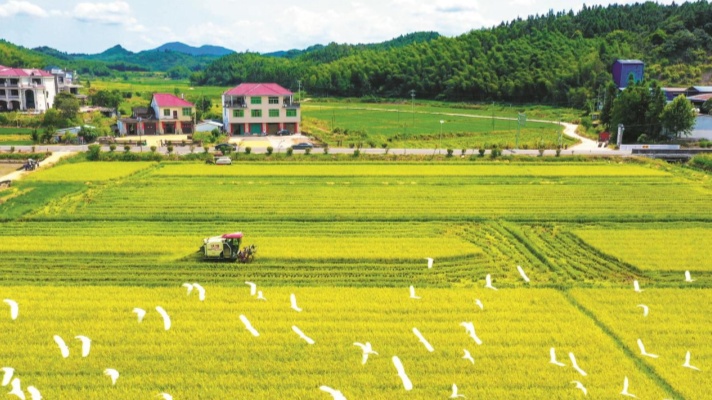
On July 10th, the National Bureau of Statistics released data: In 2026, the planting area of summer grain in China will be basically stable, with a steady increase in yield per unit area. The summer grain output will reach 301.49 billion catties, breaking through 300 billion catties for the first time, an increase of 2 billion catties from the previous year, and achieving another bumper harvest.
The summer harvest is abundant, and the hard work of farmers has come to an end. The next season of cultivation will continue; A solid foundation has been established to stabilize the annual grain production, providing strong support for responding to the complex and severe international situation, promoting economic stability and improvement, and achieving a good start to the 15th Five Year Plan.
A bountiful harvest is hard won. Behind this, there is not only the support of good policies and human efforts, but also the emergence of new agricultural productivity in the fertile field.
From the perspective of a wheat variety resistant to sprouting - Strengthening the foundation of food security
Wu Jinjun, a large-scale grower in Qifang Town, Zaoyang City, Xiangyang City, Hubei Province, has planted over 1000 acres of wheat. From late May to early June this year, many areas in Hubei Province experienced heavy rainfall and severe convective weather, which posed significant challenges to wheat harvesting.
Mature wheat ears are most afraid of sprouting after rain, which can affect the quality and processing of wheat. In recent years, we have made many attempts in variety. Three years ago, Wu Jinjun took out a portion of the land to test planting "Kenmai 58", and this year he added "Emai 30", both of which have good resistance to sprouting. During this year's harvest, there were consecutive rainy days. Only about 20% of the plots planted with these varieties had 'white pointed' wheat ears, and the average loss per mu was recovered by about 200 yuan, "said Wu Jinjun.
Zhu Jingzhan, the head of the Wuhan Comprehensive Experimental Station of the National Wheat Industry Technology System and the deputy director of the Grain Crop Research Institute of Hubei Academy of Agricultural Sciences, introduced that "Kenmai 58" has been widely planted in Hubei, breaking the record for high yield of rice and wheat in Hubei twice, with a maximum yield of 636.4 kilograms per mu.
This year, the national summer grain yield reached 378.8 kilograms per mu, an increase of 3.2 kilograms or 0.8% compared to the previous year; The wheat yield per mu is 402.6 kilograms, an increase of 3.4 kilograms or 0.9%. The solid foundation of production capacity cannot be separated from the support of the seed industry. 'Kenmai 58', 'Yangmai 53', 'Yannong 999', 'Zhongmai 578'... One grain of high-quality seeds effectively respond to weather changes, support large-scale yield improvement and industrial quality and efficiency enhancement, and are the 'password' for the continuous improvement of China's food security level.
The outline of the 15th Five Year Plan proposes that during the period, the comprehensive production capacity of grain will reach about 1.45 trillion catties. How to achieve the goal in the face of the complex situation of tightening resource and environmental constraints and increasing fluctuations in the international supply chain?
It is urgent to take agricultural new quality productivity as the fundamental driving force, promote the leap of grain production from resource consumption to innovation driven, and fundamentally consolidate the foundation of production capacity, "said Cheng Guoqiang, a professor at Renmin University of China and dean of the National Institute of Food Security Strategy.
Since the implementation of the Seed Industry Revitalization Action, more high-yield, high-quality, green, cost saving, and specialized varieties have been accelerated for breeding. China's germplasm resources have become more solid, and the level of seed source security has steadily improved. Data shows that the area of self selected crop varieties in China exceeds 95%, and the coverage rate of good varieties exceeds 96%. Chinese grains mainly use Chinese varieties.
The period of the 15th Five Year Plan is a crucial stage for building agriculture into a modern large-scale industry and for the high-quality development of the seed industry. The relevant person in charge of the Ministry of Agriculture and Rural Affairs stated that we will vigorously promote innovation and research, concentrate our efforts on solving problems, filling gaps, strengthening advantages, and controlling risks, accelerate the realization of self-reliance and self-reliance in seed industry technology, and further consolidate the foundation of food security.
From a farmer crossing provinces to watch - Improving the efficiency of the entire agricultural production chain
Dong Song, the captain of the Shandong Songdi Cross District Machine Harvesting Team, is a post-90s and experienced veteran machine operator. Dong Song and his machine harvesting team set off from Wuhan, Hubei in May, passing through Nanyang, Henan, Jinan, Shandong, Tangshan, Hebei and other places, harvesting wheat all the way for nearly two months. More than 50 Lovol Valley God harvesters, with an average harvest of over 6000 acres per harvester, have overall harvested over 10000 acres more than last year.
Mechanical harvesting is a technical job, and the real skill is to harvest it quickly and well, "Dong Song said. This year, the agricultural machinery operating system has been upgraded to real-time sensing of crop status and automatic speed reduction. "Even if there is a lot of rain, the drum has basically not been blocked.
The words' three summers' and 'grabbing' have become keywords. The daily wheat harvest area in China has exceeded 20 million mu for three consecutive days, and in Henan Province, 60.41 million mu has been harvested in six days... In the "rush harvest war", intelligent agricultural machinery is the "main force". Data shows that over 17 million sets of various agricultural machinery have been invested nationwide, including more than 800000 combine harvesters and over 200000 cross regional operations.
As of now, there are over 4000 types of domestically produced agricultural machinery products, which can meet more than 90% of the domestic market demand; The comprehensive mechanization rate of crop cultivation and harvesting reached 76.7%. At the same time, Beidou positioning and operation monitoring have become standard equipment, with mainstream models feeding up to 10 kilograms per second.
The upgrading of agricultural machinery and equipment is an important symbol of the overall efficiency improvement of China's agricultural production chain. Behind this is the efficient implementation of policies that benefit agriculture, continuous technological breakthroughs, and the intensified promotion of actions to address shortcomings in agricultural machinery and equipment.
The relevant person in charge of Weichai Lovol introduced that during the 14th Five Year Plan period, the company invested over 3 billion yuan in research and development, and has successively overcome multiple challenges such as power shifting and large feeding capacity harvesters. Optimize the operating parameters such as the drum speed and screen box amplitude of the harvester, reduce problems such as grain spillage, entrainment, and breakage, and control the comprehensive harvesting loss rate within 0.8%
To build a higher-level, higher quality, more efficient, and more sustainable food security system, we must target the entire agricultural production chain and continuously improve the level of agricultural mechanization and intelligence. The relevant person in charge of the Ministry of Agriculture and Rural Affairs stated that they will continue to promote technological innovation and achievement transformation, continuously shorten the research and application cycle of agricultural machinery, and provide stronger and more powerful equipment support for practicing the concept of big food and building a diversified food supply system.
From the perspective of an artificial intelligence mini program - enhancing the ability to respond to food production risks
In Tonglu County, Hangzhou City, Zhejiang Province, after harvesting wheat, rice seedlings have grown to a height of 40 centimeters. This area belongs to the largest rice wheat rotation zone in China - the wheat zone in the middle and lower reaches of the Yangtze River. Compared to the Huanghuai wheat growing region, wheat in rice stubble is often plagued by Fusarium head blight and waterlogging.
To address these challenges, Xu Xing, the head of Fengyang Family Farm in Tonglu County, started using the "Maijitong" mini program since wheat planting in November last year. It's like having an additional handheld assistant, "he said.
The mini program was developed by a team from Zhejiang Academy of Agricultural Sciences. When the main interface is opened, functional modules such as wheat suitable sowing period prediction, precise nitrogen supplement calculation for straw returning, identification and green protection of weeds/pests and diseases in wheat fields, extreme weather forecasting and emergency disaster reduction technology come into view.
Xu Xing said that the mini program can view precipitation, temperature changes, and wheat disaster warnings for the next 15 days, and will also simultaneously push field management measures such as stain prevention, antifreeze, and pest control.
The development team relies on multidisciplinary theories such as wheat growth and development, soil fertilizers, plant protection, and agricultural meteorology, combined with field experiment investigation results and intelligent algorithms, to 'feed' a series of research results and basic databases into the mini program, which can achieve millisecond level warning and help users achieve 'knowing the weather and working'. "Su Yao, an expert in ecological management and production area environmental governance of southern wheat fields in the national wheat industry system and associate researcher at the Institute of Environmental Resources and Soil Fertilizer of Zhejiang Academy of Agricultural Sciences, introduced that the team is still continuously optimizing regional differentiation models, iteratively optimizing agricultural mechanism algorithms and image recognition models, and gradually expanding the application area of the mini program.
This year's summer grain production has not only overcome challenges such as continuous rainy planting periods, weak seedling conditions before winter, and increased outbreaks of pests and diseases in the middle and later stages, but also responded to international market risks such as severe fluctuations in fertilizer prices, demonstrating strong resilience.
Resilience improvement is driven by technological innovation. In Cheng Guoqiang's view, "to strengthen industrial resilience, it is necessary to be able to accurately identify agricultural system risks, establish a defense system for effective supply of important agricultural products such as grain through intelligent disaster warning and intelligent production operations, and form a full cycle risk prevention and rapid response mechanism
Not only the "Maijitong" mini program, but in recent years, with the further development of new technologies such as 5G, artificial intelligence, and digital twins, various intelligent monitoring devices have achieved all-weather accurate perception of farmland environment and crop growth. Remote control, automatic cruising of agricultural machinery, and other synchronous improvements have enhanced the level of management refinement, promoting agricultural production from "relying on experience" to "based on data", and unleashing greater potential in vast fields.
One of the main expected targets for economic and social development this year is a grain output of around 1.4 trillion catties. Pushing forward with pressure and continuing season after season. Currently, the national summer sowing of grain has been basically completed, and grain production has fully entered the summer management stage. From the No. 1 central document of the Central Committee of the Communist Party of China this year emphasizing "developing new agricultural productivity in line with local conditions", to the "strengthening agricultural science and technology and equipment support" clearly proposed in the Outline of the "Fifteenth Five Year Plan", to the recently released "Fifteenth Five Year Plan for Accelerating Agricultural and Rural Modernization", which clearly defined "making major breakthroughs in developing new agricultural productivity", through technology iteration, model innovation, system reconstruction, etc., the new agricultural productivity will further enhance the supply guarantee ability of food and other important agricultural products, providing important strategic support for promoting Chinese path to modernization.
Edit:He Chuanning Responsible editor:Su Suiyue
Source:People's Daily
Special statement: if the pictures and texts reproduced or quoted on this site infringe your legitimate rights and interests, please contact this site, and this site will correct and delete them in time. For copyright issues and website cooperation, please contact through outlook new era email:lwxsd@liaowanghn.com
 Economy
 Recommended Reading Change it











 Home
Home
