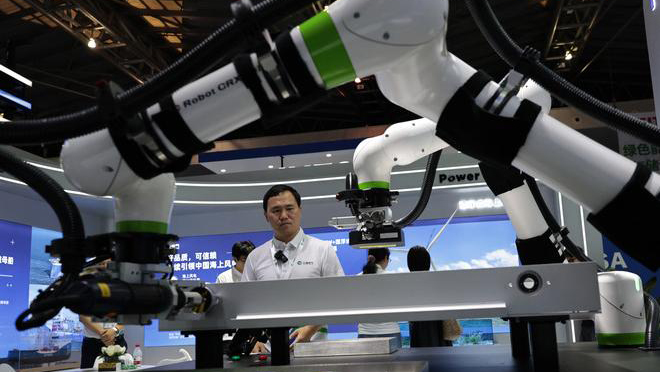
The latest batch of high-frequency data released by the State Information Center under the National Development and Reform Commission (NDRC) shows that China’s economy maintained a sound momentum of steady progress, improved quality and accumulated growth momentum in the first half of the year. On the consumption front, supply and demand improved in tandem, with robust growth registered in hot sectors including cultural, tourism and smart consumption. In terms of investment, enthusiasm for investment in cutting-edge sectors such as artificial intelligence and humanoid robots kept surging.
Since the start of this year, a package of targeted policies to expand domestic demand and boost consumption has delivered tangible results. The consumer market has featured upgraded goods, expanded service supply and thriving consumption scenarios, sustaining an overall recovery and upward trend.
From January to June, foot traffic in offline commercial complexes rose by 5.7 percent year on year. Big data on offline consumption indicates that offline payment volume increased by 2.7 percent year on year in the first six months, with goods consumption up 4.0 percent and service consumption up 0.8 percent. Demand for electronic goods remained red-hot, jumping 9.5 percent year on year. Fueled by successive holidays including the Spring Festival, Qingming Festival, May Day and Dragon Boat Festival, transport and catering spending linked to cultural tourism saw strong growth of 6.1 percent and 4.9 percent respectively year on year in H1.
On the investment side, the operating rate of cement mills stood at 32.5 percent in the January-June period, roughly flat with the same period last year, while the figure hit 41.9 percent in June, the highest level in 14 months. Capital investment in cutting-edge sectors such as AI and humanoid robots soared 118.4 percent year on year in the first six months. The winning bid value of digital infrastructure projects including computing power facilities climbed 23.0 percent year on year.
Multiple funding instruments have been issued at a faster pace this year to underpin project implementation. The NDRC disclosed that the third batch of funding for major strategic projects and key livelihood initiatives was rolled out recently, allocating 193.5 billion yuan of ultra-long-term special treasury bonds. With this issuance, the full list of such projects for 2026 has been completed, channeling 800 billion yuan to support 1,417 major projects. As for special-purpose bonds, national new issuance fell 4.3 percent year on year from January to June, yet June’s issuance topped 570 billion yuan, hitting the monthly high for this year and growing 8.5 percent year on year.
Xing Yuguan, Associate Research Fellow with the Big Data Development Department of the State Information Center, noted that fixed-asset investment enjoyed solid funding support in H1. Construction of major strategic and livelihood projects as well as six key infrastructure networks accelerated, while investment in high-tech sectors like AI continued to heat up. The investment landscape featured stable overall volume and optimized structure, delivering benefits for both near-term growth and long-term development.
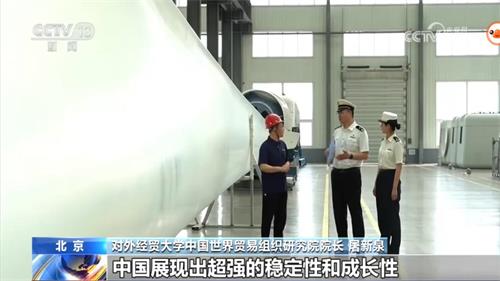
Amid recovering domestic demand, China’s foreign trade demonstrated strong resilience and global competitiveness in the first half of the year. Exports of high-tech and high-value products gained robust momentum, with rising intelligence, innovation and value added embodied in outbound shipments, marking more notable progress in promoting high-quality imports and exports.
Statistics show that the average daily container throughput at ports rose 6.7 percent year on year in January-June, and average daily cargo throughput edged up 1.3 percent. The average deadweight tonnage of ships departing major ports each day grew 9.6 percent year on year, with a 17.5 percent surge in June alone; the average deadweight tonnage of arriving vessels went up 2.4 percent year on year, with a 2.9 percent rise in June, both trending upward. The average number of daily international cargo flights increased 4.6 percent year on year, driven by sustained strong export demand for high-value-added products represented by electronic goods.
As for the industrial sector, industrial operations maintained stable growth, fresh industrial momentum and optimized structural quality in H1. Emerging tracks led by AI witnessed explosive growth, the innovation and industrial chains accelerated in-depth integration, the proportion of core hard tech steadily rose, and the innovation engine for high-quality development gained stronger traction.
Data indicates the production heat index of industrial parks rose 3.9 percent year on year in January-June. The operational vitality of start-ups climbed 1.0 percent year on year, and that of tech-innovation enterprises advanced 3.1 percent. The number of granted patents for strategic emerging industries grew 15.6 percent year on year in H1, with a 30.3 percent year-on-year jump in June. Granted AI-related patents surged 34.8 percent year on year in the first six months, and the June reading hit 38.3 percent.
Xing Yuguan commented that backed by more proactive macro policies, China’s economy maintained a sound momentum of steady progress, improved quality and accumulated growth momentum throughout the first half of 2026. The economy’s fundamental resilience strengthened continuously, drivers for innovative development shifted faster, and overall quality and efficiency improved steadily, laying a solid foundation for a good start to the 15th Five-Year Plan period. (Outlook New Era)
Edit:Liu Zhiyu Responsible editor:Li Yulu
Source:https://www.jjckb.cn/
Special statement: if the pictures and texts reproduced or quoted on this site infringe your legitimate rights and interests, please contact this site, and this site will correct and delete them in time. For copyright issues and website cooperation, please contact through outlook new era email:lwxsd@liaowanghn.com
 Economy
 Recommended Reading Change it
















 Home
Home
