During a recent inspection tour of Dezhou, Shandong Province, General Secretary Xi Jinping emphasized that the modernization of agriculture and rural areas bears on the overall progress and quality of Chinese modernization. Solid measures must be taken to deliver all relevant work, with focused efforts to boost agriculture’s overall production capacity, quality and efficiency, and secure stable supply of grain and other key agricultural products. This statement clarifies the strategic significance of work related to agriculture, rural areas and farmers (the “Three Rural Issues”), identifies boosting agricultural overall production capacity, quality and efficiency as the primary direction for advancing agricultural and rural modernization, and provides important guidance for driving high-quality agricultural development and accelerating the building of a strong agricultural country.
Steadily lifting the production capacity and supply security of grain and other major agricultural products stands as the top priority for advancing agricultural and rural modernization. As a large developing country with a population of over 1.4 billion, food security has always been a matter of national strategic importance. Only by continuously upgrading overall agricultural production capacity can we effectively strengthen food security safeguards and firmly hold our rice bowls in our own hands.
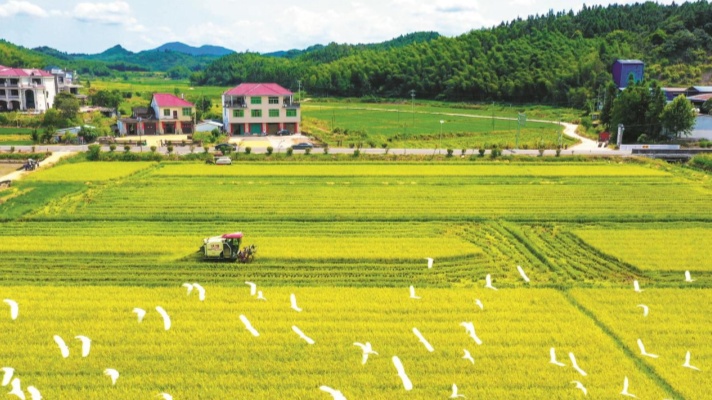
Modern agricultural comprehensive production capacity is far more than a single figure of per-mu yield; it represents a systematic supply capacity formed through the coordinated coupling of farmland, water conservancy, agricultural machinery, agricultural technologies, disaster prevention systems and new-type agricultural business entities. The key to expanding production capacity lies in fully implementing the strategies of “storing grain in land and storing grain in technology”, stepping up farmland protection and quality improvement, and reinforcing support for agricultural sci-tech innovation, application and equipment. To this end, resolutely safeguarding the 180-million-mu farmland redline and continuously upgrading high-standard farmland form the hardware foundation for solid agricultural production. Pressing ahead with breakthroughs in seed industry revitalization and popularizing modern agricultural technologies such as smart planting and breeding, green pest and disease prevention, and integrated water and fertilizer management constitute the core driving force to unlock production potential. Located in the core grain-producing belt of the Huanghuaihai Plain, Dezhou has set its sights on the integrated construction target of “1.5 tons of grain per mu”. It coordinates modern agricultural elements including fertile farmland, superior seeds, advanced machinery, sound techniques and effective institutions, carries out contiguous upgrading of high-standard farmland, continuously consolidates the foundation for stable and increased grain yields, and drives widespread growth in per-unit grain output.
Boosting production capacity addresses the fundamental challenge of “guaranteeing aggregate supply and securing food safety” in modern agriculture, while elevating quality and efficiency targets deep-seated contradictions in traditional agriculture such as unbalanced industrial structures and sluggish growth in farmers’ incomes. For a long time, China’s agricultural development has suffered structural shortcomings: prioritizing output over quality, focusing on planting and breeding rather than industrial chains, and emphasizing production over operation. These gaps lead to insufficient supply of high-quality agricultural products, limited value-added space across the full industrial chain, and restrict the overall quality of agricultural modernization. The “1.5 tons per mu” grain production initiative, which has been rolled out across multiple regions, breaks away from the narrow mindset of pursuing yield growth alone and establishes a complete system for upgrading quality and efficiency across the whole industrial chain. On the production end, standardized and green planting and breeding are promoted to uphold the threshold of agricultural product quality safety. On the circulation end, weak links in on-site storage and cold-chain logistics are remedied to reduce post-harvest losses and unclog bottlenecks connecting production and sales. On the operational end, support is extended to new-type entities including family farms and farmers’ cooperatives. Relying on favorable agricultural policies and socialized services, moderate-scale operations are developed to achieve parallel progress in stable yields, improved quality and higher incomes. Practice has proven that only by simultaneously expanding production capacity, optimizing product quality and raising operational efficiency can we reshape the value of the agricultural industry, unleash internal vitality in rural areas, make agriculture a promising sector and farming an attractive occupation.
China is now at a critical juncture marking the launch of the 15th Five-Year Plan period and the accelerated drive to build a strong agricultural country. Dual improvements in production capacity alongside quality and efficiency represent not only a major task to shore up weaknesses in agricultural and rural modernization, but also a strategic lever to empower agricultural transformation and upgrading and serve the broader cause of Chinese modernization. Agricultural and rural modernization entails comprehensive, systemic transformations covering industry, ecology, governance and people’s livelihoods, with industrial upgrading, improved living environments, sound grassroots governance and rising farmers’ incomes closely interlinked. Standing at a new stage of development, we must pursue balanced progress in output and capacity, production and ecology, yield growth and income increases, and coordinate the development of technology-driven, green, high-quality and brand-based agriculture.
On the one hand, we will consolidate the foundation of production capacity: unswervingly uphold the farmland redline, strive for self-reliance in seed industry science and technology, build a robust agricultural disaster prevention and mitigation network, and comprehensively reinforce the shield of national food security. On the other hand, we will unlock industrial value-adding potential by deepening agricultural green transition, standardized production, full industrial chain upgrading and cultivation of regional public brands. We will improve close interest linkage mechanisms that connect farmers to industrial operations, and ensure premium prices for high-quality agricultural goods. Meanwhile, we will deepen market-oriented reforms for the allocation of urban and rural factors, smooth channels for talent, technology and capital to flow into villages, and refine a full-range agricultural socialized service system. Two-way flows of urban-rural factors will fuel industrial upgrading, speed up the fostering of new quality productive forces in agriculture, and develop agriculture into a modernized major industry.
Agriculture forms the foundation of a nation; a solid foundation ensures national peace and stability. At present, the most arduous and heavy tasks in building a modern socialist country in all respects remain in rural areas. Realizing agricultural and rural modernization constitutes a major mission for building a modern socialist country. We must place higher priority on boosting agriculture’s overall production capacity, quality and efficiency. We will rely on solid production capacity to safeguard the foundation of food security, and leverage quality and efficiency upgrading to fuel development momentum. We will coordinate the synchronized advancement of production capacity expansion, product quality improvement and ecological protection, push for higher agricultural returns, larger farmers’ incomes and greater rural vitality, and lay a solid “Three Rural Issues” foundation for advancing Chinese modernization through tangible achievements of stronger agriculture, more beautiful countryside and wealthier farmers.(Outlook New Era)
Edit:Liu Zhiyu Responsible editor:Li Yulu
Source:www.gmw.cn
Special statement: if the pictures and texts reproduced or quoted on this site infringe your legitimate rights and interests, please contact this site, and this site will correct and delete them in time. For copyright issues and website cooperation, please contact through outlook new era email:lwxsd@liaowanghn.com
 Economy
 Recommended Reading Change it







 Home
Home
