Lifting one feather lightly, seeing the nine tripods abruptly ": Fuzhou's bodice lacquerware interprets the beauty of contrast
2026-07-15
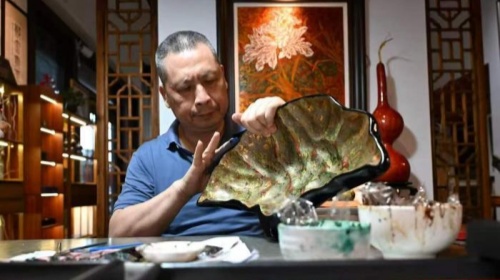
Zheng Yuntao, a master of traditional Chinese arts and crafts and a representative inheritor of Fuzhou's intangible cultural heritage, is creating a vase shaped utensil by shaping it with soil, making gypsum molds to make inner tubes, and layer by layer mounting it with ramie cloth, tile ash, and raw lacquer. After drying in the shade, the inner tubes are removed when the body is firm, forming the prototype of lacquerware.
The production process of Fuzhou's bodice lacquerware is extremely exquisite. Taking the Buddha's hand as an example, just one finger may need to be broken down into multiple pieces to create the bodice, "Zheng Yuntao told reporters from China News Service. After the prototype of the lacquerware is formed, it still needs to go through processes such as scraping, painting, and drying in the shade, sometimes adding several layers of gold foil and colored paint, and finally going through dozens of processes such as polishing, polishing, and cleaning, taking several months to complete the transformation from lacquerware.
In Zheng Yuntao's studio, a curved vase catches the eye. Seemingly heavy tools, when picked up, they are as light as feathers. Chinese cultural master Guo Moruo once praised Fuzhou's second lacquerware factory after visiting it in 1962, saying that "one feather is light when lifted, and nine tripods are abrupt when viewed".
Fuzhou is known as the "capital of China's emerging lacquer art" and is a major center of lacquer art in modern China. In 2006, Fuzhou's lacquerware decoration techniques were included in the first batch of national intangible cultural heritage list. Fuzhou's lacquerware is commonly referred to as one of the "Three Treasures" of traditional Chinese craftsmanship, along with Beijing's cloisonn é and Jiangxi's Jingdezhen porcelain.
Yu Weiping, Vice Chairman of the Fujian Folk Literature and Art Association and former Dean of the Fujian Arts and Crafts Research Institute, introduced that Fuzhou's bodice lacquerware developed on the basis of inheriting ancient lacquer culture. Shen Shao'an, the founder of bodice lacquerware production techniques in the Qing Dynasty, boldly innovated traditional techniques and laid the foundation for the craft system of Fuzhou's bodice lacquerware.
Yu Weiping believes that Fuzhou's lacquerware has broken through the traditional heavy and solid form of lacquerware, creating a unique aesthetic of "light as floating clouds and hard as gold and stone", and enriching the expressive language of Chinese lacquer art.
The inheritance of this traditional skill also faced challenges at one point. Huang Shoukun, a Taiwanese artist who has been "on the market" for many years and a provincial-level representative inheritor of Fuzhou's lacquerware painting and decoration skills, said that Fuzhou's lacquerware has gone through inheritance and has entered the daily life of the people from temple ceremonial objects. However, most of the practitioners are older generation artists, and young talents are scarce.
In Huang Shoukun's Fujian Taiwan non heritage cultural and creative exchange space located in Guilin Village, Qiduo Town, Luoyuan County, Fuzhou City, there is a wide variety of large-scale lacquerware installations, lacquer beads, lacquer painted butterfly pendants and other small cultural and creative products. Several of his apprentices are learning the key techniques of Fuzhou's lacquerware.
Traditional skills are radiating new vitality and energy in contemporary times. In October 2020, the Shen Shao'an Lacquer Art Museum in Fujian Province, which integrates collection, exhibition, research, and education, was officially opened to the public in Fuzhou. The founder of the museum, Lin Zhengjia, has been exposed to lacquer art since childhood. In the early 1990s, he frequently saw lacquerware in overseas museums and auctions, and felt that it was urgent to save traditional lacquer art.
After returning to China, Lin Zhengjia visited famous experts in the industry to promote the popularization of lacquer art. The opening of the Lacquer Art Museum is aimed at revitalizing the long dormant 'Eastern treasures', "he said. (Looking into the New Era)
Edit:Sun Kenan Responsible editor:Chen Jie
Source:chinanews.com.cn
Special statement: if the pictures and texts reproduced or quoted on this site infringe your legitimate rights and interests, please contact this site, and this site will correct and delete them in time. For copyright issues and website cooperation, please contact through outlook new era email:lwxsd@liaowanghn.com
 Recommended Reading Change it








 Home
Home

