Frequent robot leasing disputes, how to determine responsibility
2026-07-15
Humanoid robots and other intelligent robots are rapidly entering ordinary people’s daily lives. As their application scenarios keep expanding, the robot leasing business model has gained momentum.
On July 4, 2026, the China Humanoid Robot Hundred Talents Committee released an initiative to standardize and guide the development of emotional companion humanoid robots. It called for strengthened quality management, guaranteed safe product operation, and effective prevention of risks of personal injury to users. On the same day, the Robot Branch of the China Machinery Industry Federation issued another initiative on jointly practicing technology for good and boosting the sound development of the robotics industry.
On June 8, 2026, the General Office of the Ministry of Industry and Information Technology and the General Office of the State-owned Assets Supervision and Administration Commission jointly issued a circular on launching a special 2026 field training campaign for humanoid robots and embodied intelligence. The document encourages exploration of the "Robot-as-a-Service (RaaS)" model. Commercial innovations including utility-based payment and operational leasing will lower entry barriers for users and accelerate market-oriented promotion.
Data from Qichacha shows that as of April 2, 2026, there were 153,000 active robot leasing enterprises nationwide. A total of 38,200 such firms were newly registered in 2025, representing a year-on-year increase of 55.7%. While the robot leasing market booms, disputes over safety liabilities and rights division have become increasingly prominent. Accidents frequently occur during leasing operations: robots may accidentally injure passers-by or damage venue facilities due to equipment malfunctions, site environment defects and other factors, sparking widespread public discussion. The allocation of liability for such incidents has become a core concern across the industry.
Reporters from Legal Daily recently conducted interviews to sort out liability allocation rules for accidents arising from humanoid robot leasing.
Single Root Cause: Liability Falls Solely on Lessors
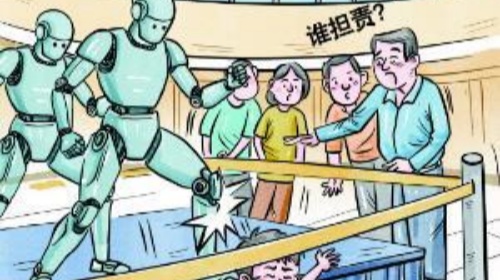
On a morning in March 2026, four humanoid robots staged a performance on a stage inside a shopping mall in Linyi City, Shandong Province. The eye-catching show drew crowds of shoppers. Though on-site staff repeatedly warned visitors to stay back and set up safety warning lines, curious children climbed over the barriers to touch the robots at close range. An accident ensued: as one robot executed a continuous martial arts sequence, its mechanical leg struck a boy who had crossed the line, leaving him injured.
Liu Xiaocheng, a local robot leasing operator in Shandong, still feels uneasy recalling the incident. "Once the robot receives operating instructions, it cannot halt its movements instantly. We comforted the injured child immediately after the accident and accompanied his family for medical examinations," Liu told reporters. Ultimately, his company covered all medical bills and nutritional compensation for the minor.
Such accidents are not isolated cases. Tang Yixiang, a leasing merchant from Beijing White Dolphin Technology Co., Ltd., also encountered a robot malfunction during a performance in May 2026. He brought two humanoid robots to a school in Wuhan, Hubei Province for a show. During preparation, an operator mistakenly triggered the robot’s damping mode. The unit lost balance and fell while rising, damaging its built-in camera. Tang explained that since the accident stemmed from operational error by his staff, his company bore all repair costs.
Liu Xiaocheng said his firm’s leasing contracts only cover basic clauses such as payment terms and performance duration, with almost no detailed provisions clarifying liability for accidents.
According to his industry observations, a common consensus prevails across the sector: humanoid robots require manual control. Though operational accidents are low-probability events, leasing companies generally bear full liability once harm occurs. To avoid litigation and maintain client partnerships, most lessors voluntarily compensate affected parties in full.
Multiple Contributing Factors: Complex Liability Identification
Interviews revealed that liability attribution is straightforward for accidents triggered purely by operational mistakes. Yet incidents stemming from overlapping factors including uneven ground, defective equipment and human error create tangled disputes hard to resolve.
Mr. Li, a robot leasing practitioner based in Zhejiang Province, recounted a dispute caused by ambiguous liability terms. In December 2025, his company provided humanoid robot performances for the opening ceremony of a catering shop in Hangzhou. The red carpet laid at the venue shifted the robot’s center of gravity, causing it to topple over and smash a beverage dispenser outside the store. The event organizer blamed improper operation by Mr. Li’s team.
"We had notified the organizer in advance that a flat venue surface was mandatory," Mr. Li said. Since their contract contained no clauses governing such scenarios, the two sides settled privately and split the losses equally.
To prevent accident disputes and mitigate operational risks, many lessors have adopted proactive risk control measures. Multiple industry insiders disclosed that they inspect venue floor materials, visitor flow routes and spatial layouts before accepting orders. During on-site performances, safety remains the top priority, with dedicated technicians stationed to operate robots and activate emergency stop functions at any time.
Zhang Li, Professor at the Civil and Commercial Law School of Southwest University of Political Science and Law, offered authoritative legal analysis:
If an accident mainly arises from operational negligence by lessor-assigned technicians, the lessor shall bear primary tort liability. In such cases, lessors do not merely rent out hardware but deliver an integrated package of equipment, operators and technical services. Article 1191 of the Civil Code stipulates that employers are liable for harm inflicted by employees performing work duties. After compensating third parties, employers may pursue recourse against staff who acted with intent or gross negligence.
If poor venue conditions such as uneven or slippery ground, or insufficient safety fencing by organizers constitute the main cause of an accident, the event organizer shall assume primary liability. As organizers of mass activities and managers of public premises, they fail to fulfill security obligations and must answer for resulting damages. If the root cause lies in product design or manufacturing defects, or manufacturers fail to fully disclose usage limitations, manufacturers shall bear corresponding liability.
"Many accidents stem from multiple overlapping factors," added Xu Ying, Senior Partner at Beijing Kyoto Law Firm. "For example, the robot itself lacks stability, the lessor skips pre-show on-site testing, and the organizer fails to set adequate audience isolation barriers." Such circumstances may constitute joint tort or separate torts causing identical harm. Parties compensate victims proportionally based on their respective fault levels. When fault ratios cannot be distinguished clearly, parties may split losses evenly or bear joint and several liability before settling internal compensation claims.
No Unified Standards for Equipment Damage Assessment
Industry practitioners also face prominent disputes over liability for wear, tear and damage to robots during leasing and transit.
Insiders acknowledged that high logistics and maintenance costs for humanoid robots mean damage compensation rules directly impact lessors’ profit margins. However, the industry lacks unified evaluation criteria to distinguish normal operational wear (such as minor surface scratches and joint abrasion) from damage caused by lessee negligence or improper handling.
Liu Xiaocheng, who operates a fleet of more than 20 robots, has developed internal assessment rules. Lessees cover compensation for obvious man-made damage; faint surface scratches without signs of violent treatment are categorized as routine wear with no compensation required.
He explained that damaged equipment generates not only direct maintenance fees but also substantial hidden losses from missed rental orders during repairs. Larger leasing firms with stable profit buffers can absorb routine maintenance expenses easily.
By contrast, small-scale lessors with limited capital rely heavily on equipment deposits to offset repair costs. Reporters learned that daily security deposits for ordinary humanoid robots generally amount to several thousand yuan, while deposits for high-end models nearly equal the full equipment value. Without professional third-party damage appraisal institutions in the industry, compensation standards are unilaterally set by lessors. Disputes frequently erupt when lessors deduct deposits over alleged artificial damage.
Mr. Zeng, a leasing merchant in Hunan Province, was embroiled in such a deposit dispute in October 2025. A client rented a humanoid robot under a dry lease arrangement (equipment only, no accompanying operator), paying full rent and deposit. Upon the robot’s return, Mr. Zeng detected jamming in its mechanical arm joints and withheld part of the deposit to cover factory repair fees. The customer denied improper operation, claiming the joint fault existed prior to delivery and demanded a full deposit refund.
Failed private negotiations led the client to file a lawsuit, arguing unreasonable damage assessment and illegal deposit deduction. Faced with incomplete evidence collection and time-consuming litigation procedures, Mr. Zeng ultimately returned the full deducted deposit voluntarily.
Frequent damage appraisal disputes have driven the industry to explore insurance solutions. Media reports state that on April 17, 2026, PICC Property and Casualty Company Limited completed China’s first insurance claim settlement for embodied intelligent robots. A robot owned by Qiantianzu, a Shanghai robot leasing platform, tipped over during operation and received compensation of RMB 5,976.87. Industry commentators noted the milestone marked the formal entry of embodied robot insurance from policy design into real commercial scenarios, followed by successive subsequent claim settlements under the same coverage type.
Nevertheless, such insurance products remain underdeveloped and low in market penetration. Interviews revealed most lessors lack knowledge of insurance purchase channels and clauses. Practitioners commented that robot insurance is still in its infancy, with significant work remaining to refine policy terms and expand market outreach.
(Outlook New Era)
Edit:Sun Kenan Responsible editor:Chen Jie
Source:legaldaily.com.cn
Special statement: if the pictures and texts reproduced or quoted on this site infringe your legitimate rights and interests, please contact this site, and this site will correct and delete them in time. For copyright issues and website cooperation, please contact through outlook new era email:lwxsd@liaowanghn.com
 Recommended Reading Change it









 Home
Home

