A Monument of Military Industry on the Taihang Mountains
2026-07-15
Taking advantage of the natural terrain, stones were piled up to create dwellings. Located in the town of Taoquan in the township of Huatuo Village, which is situated among the towering peaks of the Taihang Mountains, it has long been renowned as the “Magnificent Peak of the West, known as Tianjian” for hundreds of miles. Had it not been for the turmoil of the War of Resistance Against Japanese Aggression during the 1930s and 1940s, this ancient village atop the mountain could have been considered a peaceful paradise untouched by the world – fruit trees cover the hills, and the smoke from cooking rises gently.
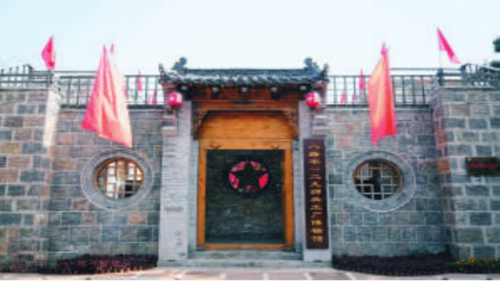
However, when the Japanese invaders’ iron hooves entered the heartland of southern Hebei, the Eighth Route Army and the local populace took up the responsibility of resisting the enemy and saving the country. In 1938, the first military factory in the southern Hebei region – the 129th Division Military Factory of the Eighth Route Army in Huachou Village – was established. It became an immortal monument of military industry in the depths of the mountains and dense forests.
We drove to Hua Tou Village, following the winding mountain road. Who could have imagined that the flat, smooth asphalt road in front of us was once a narrow, rugged path full of ravines and difficult terrain, which was also the only way to climb up the mountain at that time. The villagers moved stones to fill in the ravines, chiseled out rocks to create a path, using “traditional methods” such as horse-drawn and shoulder-carried transportation, as well as manual pushing and carrying, to transport heavy equipment up the mountain.
“At that time, the workshop was located in the courtyard of the villagers’ homes. The villagers cut down the fruit trees to make gun stocks.” Guo Yu-jia, an old party member from Huatuo Village, gently ran his hand over the weathered bullet marks on the ancient stone wall and explained to me: “When the military factory was first established, it faced numerous challenges. There were no production facilities. The villagers voluntarily moved into caves and stone hermitages, freeing up their homes for the military factory’s use. Due to a lack of transportation tools, they even harnessed their own livestock to transport supplies for the troops.”
When the military and civilians work together in harmony, their efforts are unstoppable. Factories of various types were built one after another, and military supplies were continuously transported to the front lines in preparation for the war. As a result, Huatuo Village came to be known as the renowned “military industry special village” of the base area.
Walking through the cobblestone alleys of Hua Tou Village, the red slogan inscribed on the walls, “Do it yourself and enjoy abundant clothing and food,” stands out prominently. The gentle breeze brushes against the walls, as if one can hear the rhythmic shouts and machinery sounds of the ancestors who worked tirelessly day and night to produce military supplies.
In 1942, the Japanese military conducted numerous “sweeping operations” and “pacification campaigns” in the southern Hebei region, causing the situation of the southern Hebei base area to deteriorate further. In order to ascertain the precise location of the military factory, the enemy infiltrated traitors into the surrounding villages of Michen. However, the secrecy measures of the military factory had already taken deep root. When confronted with questions, not only the workers within the factory remained tight-lipped, but even the children from Huatuo Village responded flawlessly. Despite repeated attempts at surveillance going unproductive, the Japanese were infuriated, viewing this hidden “red stronghold” deep within the Taihang Mountains as a “thorn in their eye” and a “biting thorn in their flesh.”
“The owner of this heavily corroded machete was Guo Zhang, a soldier from the Eighth Route Army.” According to the tour guide at the Museum of the 129th Division Arsenal of the Eighth Route Army in Huatou Village, in the face of the Japanese enemy’s “pursuit and encirclement,” Guo Zhang led a small detachment in a valiant defense to protect the civilian population and the arsenal as they were being relocated, ultimately making the ultimate sacrifice.
Protecting one’s family and country is a responsibility that falls upon every individual. During the journey of relocation, the villagers risked their lives to shield the military factory. Women and children actively participated in the transportation of supplies. Together, the military and civilians built a “steel fortress” for military production behind enemy lines. The deep sense of national pride and familial affection that is ingrained in their blood shone brightly amidst the rugged stone walls of the Taihang Mountains.
Time has passed, and the former site of the military factory has now been transformed into a patriotic education base. Every room, every object, every brick and tile remains unchanged, much like an elderly person who has weathered many hardships but has not lost his original resolve. He quietly recounts the indelible story of the red era. (Looking into the New Era)
Edit:Liang Yuhan Responsible editor:Wanzi
Source:people.cn
Special statement: if the pictures and texts reproduced or quoted on this site infringe your legitimate rights and interests, please contact this site, and this site will correct and delete them in time. For copyright issues and website cooperation, please contact through outlook new era email:lwxsd@liaowanghn.com
 Military
 Recommended Reading Change it















 Home
Home
