One Friday afternoon, as a battalion camp of an Army brigade was about to enter its weekend rest period, a normally relaxed and harmonious atmosphere in one squad was tinged with some discordant emotions. Soldier Xiao Wang said, "It's my turn for duty this week, so going home is off the table again."
Upon hearing this, a fellow soldier who was packing his bag to head home hesitated in his movements.
During a grassroots research visit, a reporter noticed such phenomena. As the policy allowing soldiers to return home for overnight stays became routine, some officers and men gradually began to treat the organization's warm-hearted care for the grassroots as a personal entitlement. They prioritized their own rest, leaving most of the pressure from weekend duty shifts and daily support tasks to their comrades staying behind. Once unable to leave due to duty or temporary assignments, they felt they had suffered a loss, and their work motivation correspondingly declined.
Squad Leader Liu shared with the reporter the situation when the policy was first implemented. At that time, everyone greatly cherished the opportunity to go home. Those returning home would carefully finish their current tasks and make thorough handovers before leaving, ensuring that their personal rest did not affect the normal operations of the company. They would repeatedly express gratitude before departing.
But now, that spirit has faded among some individuals. Some hastily push aside their unfinished work before leaving, or even pack up and walk out without saying a word, leaving a pile of loose ends for their comrades to clean up.
"There was a soldier who was eager to go home for the weekend but left his post before completing his work. In the end, other comrades had to step in to finish it for him." Speaking of such issues, a certain company's political instructor expressed considerable emotion. Some officers and men fail to correctly handle the relationship between the individual and the collective, taking the organization's care and their comrades' mutual assistance for granted. If this mindset is not corrected, it will gradually erode the atmosphere of unity and may even breed internal divisions.
"I haven't had a proper rest for three consecutive weeks. I have to cover for my comrades on duty and help deal with all kinds of leftover tasks. I feel quite exhausted," admitted Soldier Xiao Wang. Watching his comrades reunite with their families and relax while he remains steadfast at his post, he inevitably feels a sense of disparity.
This psychological gap also appears among some grassroots cadres. Company Commander Chen told the reporter: In a company, if one of the two principal leaders goes home according to policy, the other has to shoulder all the weekend work, sharply increasing the pressure of being on duty. It often becomes "from opening eyes to lights out, busy all day." This leaves some grassroots cadres physically and mentally drained. Gradually, a few begin to develop the mentality of "do more, bear more responsibility; do less, worry less," weakening their drive to take initiative and assume responsibility.
Analyzing these subtle contradictions and disagreements, it is not difficult to see that the root of the problem lies not in the home-stay policy itself, but in the cognitive biases of some officers and men during its implementation and the inadequacy of ideological guidance at the grassroots level. A good system originally designed to warm hearts and benefit soldiers has, due to some individuals' calculating mindset and unbalanced mentality, become a trigger for internal discord within companies. This not only hinders the personal growth and progress of those individuals but also affects the cohesion and overall combat effectiveness of the unit to a certain extent.
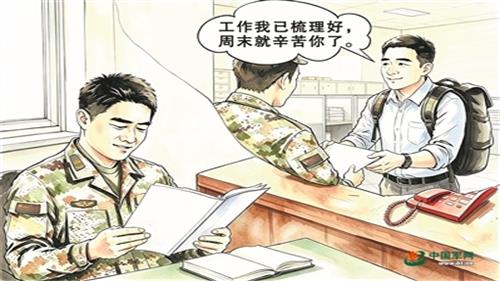
However, during the research, the reporter encountered more instances where care was transformed into motivation. Comrade Xiao Li, a propaganda officer from the political department, qualified for home stays. But every Friday, when organizing the company's movie night, she never rushed off duty. Before leaving each time, she would download the film in advance, meticulously set up the venue, outline the activity flow and safety precautions, and go through every item with her colleagues in the office, clarifying work details to ensure the activity proceeded smoothly after her departure.
"Being allowed to go home is a sign of the organization's care. The more we enjoy the convenience of the policy, the more we should take initiative, fulfill our responsibilities, and ensure continuity in our work," Xiao Li said. In her view, home stays are a warm privilege offered by the organization, and one should not slack off or burden colleagues because of it. Mutual help and sharing the load are the proper sense of responsibility and vision.
The reporter learned that many companies have already explored some effective measures. Some units reasonably schedule personnel for home visits based on task intensity, ensuring that those staying behind can also rotate for rest. Others have created a "Weekend Work Handover Confirmation Form," requiring departing personnel to formally hand over tasks to their replacements and confirm each item, thereby reducing work-related disputes at the source. Still others use squad meetings as opportunities to hold discussions on "gratitude and sharing," guiding officers and men to strengthen their collective consciousness and foster a united and orderly internal atmosphere, making everyone understand that going home is both a form of care and a responsibility, while staying behind is a contribution that deserves respect.
Concluding the research, the reporter was deeply impressed: There is an art to "handling good deeds well." Allowing soldiers to go home on weekends is a sound policy. It should enable officers and men to balance work and rest, travel light, and correct their thinking, rather than letting a few soldiers' homecomings become an additional burden for others. Only when all officers and men adopt the right mindset, cherish the care, share the load, and transform the warmth of the organization into motivation for training and combat readiness can such soldier-benefiting policies truly unite the troops, generate combat effectiveness, and continuously cultivate a camp culture of solidarity, upward momentum, and responsible action. This will lay a solid foundation for building the armed forces, making the barracks both a place of iron discipline and a home-like warmth. (Looking Ahead to the New Era)
Edit:Liang Yuhan Responsible editor:Wanzi
Source:81.cn
Special statement: if the pictures and texts reproduced or quoted on this site infringe your legitimate rights and interests, please contact this site, and this site will correct and delete them in time. For copyright issues and website cooperation, please contact through outlook new era email:lwxsd@liaowanghn.com
 Military
 Recommended Reading Change it




















 Home
Home
