A Lamp as Tiny as a Bean Illuminates the Galaxy
2026-07-16
Stepping into the Jinggangshan Revolutionary Museum, the first thing that catches the eye is a sculpture in the shape of a bronze oil lamp. On its base, the words "A single spark can start a prairie fire" are inscribed in bold, vigorous strokes. As one's gaze lingers on the lamp, thoughts drift back to that rammed-earth cottage deep in the Luoxiao Mountains. That oil lamp, burning just a single wick, trembles faintly, as if it has never been extinguished.
After the setback of the Autumn Harvest Uprising in 1927, the Workers' and Peasants' Revolutionary Army moved to the Luoxiao Mountains and established a revolutionary foothold in Jinggangshan. Under the tight blockade imposed by the enemy, salt, cloth, medicine—everything was in dire shortage in the base area, and oil was an especially precious "luxury." To conserve supplies, Comrade Mao Zedong set a rule: Units at the company level and above could use only one lamp for nighttime office work or meetings, and it could burn three wicks; when not working or meeting, no lamp was to be used. One evening, Mao sat at his desk, writing by the flickering lamplight. His guard wanted to add another wick to the oil lamp, but Mao waved his hand to stop him.
A lamp as tiny as a bean, its light barely spanning a foot, yet it carved out a space of clarity amidst the pitch-black darkness of the revolution. Through countless nights, the faint glow of this oil lamp accompanied him as he bent over his desk in contemplation. Why Can China's Red Political Power Exist? The Struggle in Jinggangshan… Article after article that illuminated the path of the revolution was written under the swaying lamplight. This oil lamp, burning only a single wick, could illuminate the handwriting on the paper, and it could also clearly reveal the boundary between public and private interests.
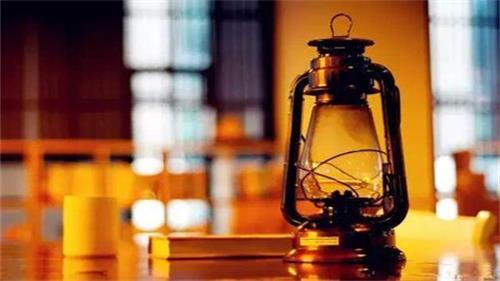
In the display case of the Jin-Ji-Lu-Yu Martyrs' Cemetery, an iron-base kerosene lamp sits quietly. Its glass chimney has darkened with age, and the base bears scars of varying depths from bumps and knocks. Silent though it is, it harbors the steadfastness and tenderness of a general of the Eighth Route Army amid the flames of war.
This lamp was used by General Zuo Quan on the front lines of the Taihang Anti-Japanese campaign. By day, he moved between positions, surveying terrain and deploying defenses. Late at night, this lamp would light up on his desk. As Deputy Chief of Staff of the Eighth Route Army, he stood before military maps drawn at a scale of 1:50,000, analyzing intelligence, simulating tactics, and orchestrating strategies with calm authority. Orders for battle were dispatched from beneath the lamp's glow to the front lines. Under that light, he was not only a wise and courageous commander but also a profound theoretician. To boost the morale of the army and civilians and to summarize combat experience, he wrote by the dim light a series of military treatises, including On the Great Victory of the Hundred-Regiment Campaign and New Victories in the Third Phase of the Hundred-Regiment Campaign, transforming battlefield practice into theoretical guidance. Zhou Enlai once praised him as "a military strategist with both theoretical cultivation and practical experience." This merit and glory are also hidden in the flame of this oil lamp that burned unceasingly night after night.
The lamp's light illuminated both the grand cause of the nation and the tender feelings of a steadfast man. Amid frequent warfare, he and his wife Liu Zhilan were separated by distance and rarely met. On that particular night, the lamplight gently brushed the letter paper as he put down four heavy characters: "Miss you, miss you, miss you, miss you." The paper was short, but the words burned with passion. No one expected that just three days after this letter was written, the artillery fire at Shiziling would shatter the peace. On May 25, 1942, while covering the breakout of the headquarters, Zuo Quan was hit in the head by shrapnel, spilling his blood on the Taihang Mountains. His life was forever frozen at the age of 37. That kerosene lamp, which had burned long into every night, like his wife Liu Zhilan, never saw his return. But the profound patriotism and devotion to family and country formed the sturdiest backbone of the Taihang Mountains.
The flames of war have dissipated, and the land has been restored. The pure, clear, selfless dedication of the Communists still burns as hot as ever. In the old house at Wushi Village, Xiangtan, a kerosene lamp burned through the night, telling the story of a revolutionary forebear deeply rooted among the people.
In October 1961, Marshal Peng Dehuai returned to his hometown for investigation and research. To grasp the most authentic conditions of the people and hear the most sincere voices, he declined the arrangement of a guesthouse and insisted on staying in his own dilapidated old house. The interior was sparsely furnished: a bed, a cabinet, a table, and a chair. Night fell early in the village, and the ordinary kerosene lamp on the desk was his sole source of light for nighttime work.
During his more than a month in his hometown, this lamp accompanied him through countless long nights. He walked through the fields, visited farming households, and inspected agricultural conditions. At night, by the dim yellow light, he sorted through visitor records, verified survey data, and bent over his desk to write reports. The flickering lamp cast shadows on his furrowed brow and reflected his deep concern for the people's food and warmth. Over thirty days, he received more than two thousand grassroots villagers and eventually produced a detailed rural investigation report. He always regarded himself as an ordinary laborer, never asking for any special treatment, eating the same meals and living in the same earthen houses as the villagers. The light of this kerosene lamp was soft and warm, yet it brightly illuminated the word "people," revealing the pure heart of Communists who breathe the same air and share the same fate with the masses.
A lamp as tiny as a bean illuminates the journey; the original aspiration burns like a torch, and the steps never cease. Over a century of storms, generations of revolutionaries have lit the lamps before them with the fire in their hearts, gathering individual glimmers into a galaxy of the times. This light is the eternal star in the depths of history, the surging flame in the bloodline of the nation. On the new journey ahead, as long as we safeguard the lamp of our original aspiration in our hearts, we will never lose our direction and will stride steadily toward the distant horizon. (Looking Ahead to the New Era)
Edit:Liang Yuhan Responsible editor:Wanzi
Source:81.cn
Special statement: if the pictures and texts reproduced or quoted on this site infringe your legitimate rights and interests, please contact this site, and this site will correct and delete them in time. For copyright issues and website cooperation, please contact through outlook new era email:lwxsd@liaowanghn.com
 Military
 Recommended Reading Change it













 Home
Home
