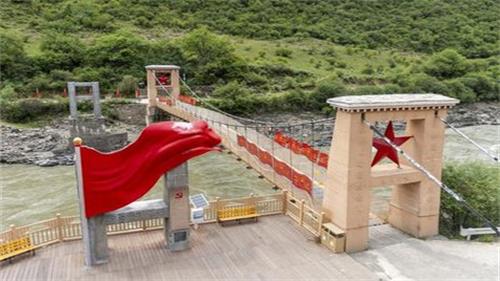
In late June, the People's Armed Forces Department of Huitong County, Hunan Province, organized militiamen to conduct an on-site educational session at the Red Army Bridge in Huangtu Village, Ma'an Town. Standing on the weathered wooden bridge and listening to the account of 91-year-old former village Party secretary Liu Fangfu, newly enlisted militiaman Wang Jianpeng's eyes reddened: "Compared to our revolutionary forebears, what are a little hardship and fatigue on the training ground?"
This educational session originated from a "ripple in thought" on the training ground.
In early summer, Huitong County experienced days of continuous rain, oppressive heat, and humidity. On the training field, intense flood prevention drills occasionally drew grumbles from some militiamen: "It's so hot—can't we lower the training intensity?"
"Though few in number, these complaints reflect a deviation in thinking," concluded Zhang Shukui, a training cadre from the county's Armed Forces Department and a militia political instructor. Some militiamen lacked a genuine understanding of "why endure hardship" and "for whom to endure hardship," and mere preaching could hardly touch their hearts.
This year marks the 90th anniversary of the victory of the Red Army's Long March. Huitong County, an old revolutionary base area, is rich in red resources. They decided to move the educational classroom to these historic revolutionary sites, using a "dialogue across time and space" to give the militiamen a profound lesson.
"This bridge—the Red Army crossed it with their lives." At the Red Army Bridge, Zhang Shukui pointed to a moss-covered old stone pier, pulling the militiamen's thoughts back to the bitter winter of 1935. Originally named Huangtu Bridge, it was destroyed by a flash flood in 1924, leaving only rotten planks resting on stone piers. On December 27, 1935, He Long, Ren Bishi, and others led the Second and Sixth Army Groups of the Red Army on their Long March through this area. Suddenly ambushed by the enemy, the Red Army soldiers engaged in fierce combat at the bridgehead. To quickly defeat the enemy, they resolutely jumped into the ice-crusted stream, bravely broke through the blockade, successfully crossed, and seized the high ground on the opposite bank.
"My father witnessed with his own eyes two Red Army soldiers die from enemy fire while shielding the villagers, falling right here at the bridgehead," said former village secretary Liu Fangfu, standing by the stream. His voice was not loud, but every word struck deep. The old man recalled that thereafter, his father brought him to the bridge every Qingming Festival to pay respects. "My father said the martyrs left their lives here—we must never forget." When emotion overcame him, Liu Fangfu choked up several times, and every militiaman present was deeply moved.
From the training ground to the Red Army Bridge—a drive of just a few dozen minutes—yet it was a spiritual dialogue spanning over ninety years.
"I used to think the Long March was just history in books. Today, I truly understand what it means to live out one's faith with one's life," confessed militiaman Zhang Hua during the discussion. He admitted he had secretly complained during training, but now thinking about it made his "face burn with shame."
Militiaman Wang Jianpeng bent down and gently touched the weathered traces on the stone pier, remaining silent for a long time. After the session, he wrote in his diary: "Crossing icy rivers in winter, facing a hail of bullets—they never complained. What right do we have to call our minor fatigue on the training ground 'difficult'?"
A transformative change touching the soul was underway. Returning to the training ground, the training cadres could clearly sense a different spirit among the militiamen. During flood prevention drills, militiamen volunteered for extra practice; some refused to leave the line even after their skin peeled from sun exposure. "Using the Red Army's stories as a mirror for our own thinking—the gap is obvious," said militiaman Liu Hao.
"Every red historic site in Huitong County is a vivid teaching resource. By moving our classroom to these sites, we aim to illuminate the present with history and challenge our sense of responsibility with our original aspirations," said a leader from the county's Armed Forces Department. They introduced that next, relying on red venues such as the Red Army battle sites and the former residence of General Su Yu, they will regularly conduct on-site teaching and immersive lessons. They will integrate the promotion of revolutionary traditions and the inheritance of red genes into the entire process of militia political education and combat readiness training, enabling militiamen to forge their faith and temper their courage by tracing their roots and finding their origins. (Looking Ahead to the New Era)
Edit:Liang Yuhan Responsible editor:Wanzi
Source:Xuexi.cn
Special statement: if the pictures and texts reproduced or quoted on this site infringe your legitimate rights and interests, please contact this site, and this site will correct and delete them in time. For copyright issues and website cooperation, please contact through outlook new era email:lwxsd@liaowanghn.com
 Military
 Recommended Reading Change it



















 Home
Home
