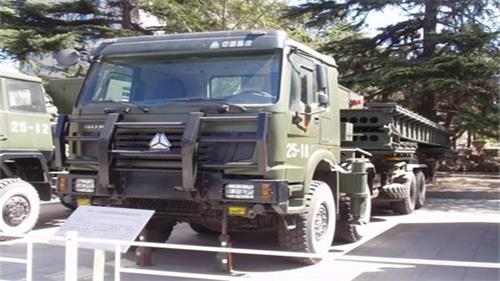
In people’s minds, field mechanized platform vehicles are often seen alongside railway lines, where they use temporary platforms to overcome the challenges of loading and unloading wheeled and tracked equipment by rail. Recently, officers and soldiers from a brigade of the Joint Logistics Support Force brought one of these vehicles onto a highway to explore ways of using it to support the loading and unloading of a new type of equipment by road.
After a new type of equipment was deployed by this unit, road transportation and loading/unloading operations became a significant challenge. Prior to this, relying on crane operations for tasks such as leveling the terrain, securing the equipment, attaching hooks for lifting, and positioning it for landing, often took a long time and was subject to constraints imposed by terrain and other factors.
“The field mechanized platform vehicle can connect railway flatcars with the ground. Could it also be used to build a ramp between road transport vehicles and the ground?” This suggestion made by Military Representative Li Lei caught everyone’s attention. However, questions soon arose: How should the inclined angle of the platform vehicle’s bridge be set to meet the standards for a specific type of equipment to climb up and pass through? Can different models of transport vehicles and platform vehicles be compatible and adaptable to each other?
“Only by taking bold risks can we pave the way for new paths.” The brigade’s operational department established a technical task force. Through dozens of rounds of actual equipment operation trials, they successfully completed the verification of the compatibility of three types of transport vehicles, optimized and adjusted over 10 key parameters, including the inclination angle of platform installations and the stability of support points, thus turning the concept of using mechanized field platforms to facilitate the loading and unloading of a new type of equipment into reality. “Compared to crane-based operations, using platform vehicles to facilitate loading and unloading reduces the time required by more than two-thirds.” stated the head of the brigade’s operational department.
The utility of the platform vehicle goes beyond this. During a mobile training exercise, a trench several meters wide appeared in front of a certain type of new equipment. The soldiers of the brigade quickly deployed the platform vehicle, erected a bridge deck, and calibrated the support structures. Within just a few minutes, they had built a steel bridge over the trench, ensuring the smooth passage of the new equipment.
“The platform vehicle serves as a mobile bridge that follows the team.” One driver told me that with the guidance and assistance from the technical department, they upgraded the anti-slip components of the trestle bridge and added slope-side anti-slip railings. This enabled various equipment to be successfully loaded and unloaded through the platform vehicle even under harsh weather conditions and soft terrain.
“A change in perspective opens up a whole new world.” According to the head of the brigade’s operational department, the experience of “transitioning” the field mechanized platform vehicle has taught them the importance of thoroughly exploring the potential of existing equipment support systems and creating various scenarios for use on railways, waterways, and roads, thereby laying a solid foundation for enhancing the military’s transportation support capabilities. (Looking into the New Era)
Edit:Liang Yuhan Responsible editor:Wanzi
Source:people.cn
Special statement: if the pictures and texts reproduced or quoted on this site infringe your legitimate rights and interests, please contact this site, and this site will correct and delete them in time. For copyright issues and website cooperation, please contact through outlook new era email:lwxsd@liaowanghn.com
 Military
 Recommended Reading Change it





















 Home
Home
