Economic powerhouse province shoulders the heavy burden, new driving force grows strongly - Perspective on the economic
2026-10-30
The economic performance reports for the first three quarters of 31 provinces have recently been released one after another. Among them, major economic provinces continue to play a role as "ballast stones", with growth rates in many regions beating the national average, new driving forces accelerating their aggregation, and the cultivation of new quality productivity accelerating. Experts interviewed believe that in the future, it is necessary to continue to expand domestic demand, stabilize expectations, cultivate long-term growth drivers according to local conditions, and safeguard the smooth operation of the economy throughout the year.
15 provinces outperform the national economy in terms of growth rate
In terms of total economic output, the top ten provinces in the first three quarters were Guangdong, Jiangsu, Shandong, Zhejiang, Sichuan, Henan, Hubei, Fujian, Shanghai, and Anhui, all of which had an economic output exceeding 4 trillion yuan. Among them, Guangdong ranked first with 111090.8 billion yuan, followed closely by Jiangsu with 108631.3 billion yuan.
From the data of the first three quarters, it can be seen that the overall recovery trend of the local economy has continued, and regional development has shown the characteristics of steady progress, differentiation and convergence. The performance of major economic provinces in China is relatively stable. Pang Ming, a member of the China Chief Economist Forum, said that the improvement of growth momentum in economic provinces does not simply rely on traditional factor inputs, but more on optimizing industrial structure and cultivating new growth points, upgrading industries, and enhancing endogenous growth momentum.
In terms of economic growth, there are 15 provinces in China that have outperformed the national growth rate of 4.6%, including Xizang, Shandong, Zhejiang, Shanghai, Anhui, Jiangsu, Beijing, Qinghai, Henan, Gansu, Ningxia, Sichuan, Inner Mongolia, Tianjin and Hubei. Among them, Xizang led the way with a year-on-year growth rate of 6.2%, while Shandong and Zhejiang ranked second in the country with a year-on-year growth rate of 5.6%.
Fu Yifu, a special researcher at Suzhou Commercial Bank, stated that the economic growth rate of major provinces is mostly in the medium to high speed range, while the economic growth rate of Shandong, Zhejiang, Shanghai and other places has rebounded, indicating that the policy effect and industrial upgrading are showing significant results.
Economic provinces have a large scale, complete industrial chains, and active market entities, and their performance often has a 'ballast stone' effect and a guiding significance. Pang Ming said that for the national economy, the first stabilization and recovery of economic provinces can help drive the coordinated development of regional industrial chains, enhance market expectations and enterprise confidence, and provide more solid support for the smooth operation of the economy throughout the year.
New momentum accelerates growth
The accelerated growth of new driving forces has significantly enhanced their role in driving the local economy.
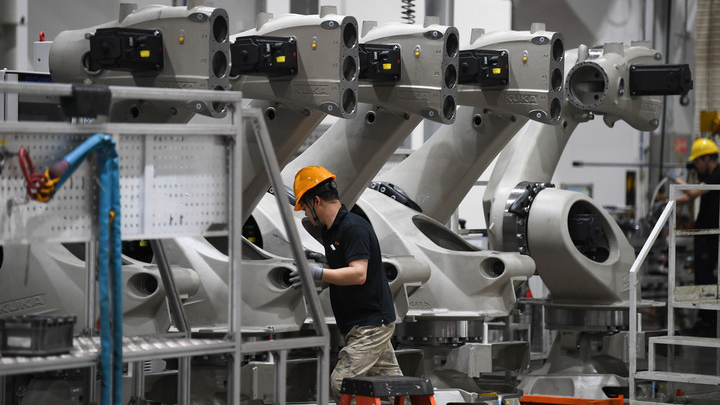
On the one hand, the conversion of industrial development momentum is accelerating, and new momentum is accumulating, significantly enhancing its contribution to economic growth. Data shows that in the first three quarters, the added value of Anhui's high-tech manufacturing industry above designated size increased by 50.3% year-on-year; Driven by the continuous growth of advantageous industries such as optoelectronic information and high-end equipment manufacturing, the added value of high-tech manufacturing in Hubei has grown rapidly, with a growth rate of 45.5% in the first three quarters and a contribution rate of 102.4% to the growth of added value of large-scale industries; The added value of high-tech manufacturing and strategic emerging industries above designated size in Beijing increased by 22.1% and 16.2% respectively (with a cross-over between the two), while the output of service robots, industrial robots, servers, integrated circuits and other products increased by 1.7 times, 47.6%, 36.8% and 20.5% respectively.
In recent years, various regions have taken technological innovation as an important lever to cultivate new growth points, promoting the aggregation of funds, talents, and industrial resources towards advanced manufacturing and strategic emerging industries. Pang Ming said that the innovation driven development strategy is being transformed into real production capacity: various regions are accelerating the layout of strategic emerging industries such as advanced manufacturing, new energy, new materials, and biomedicine; The increase in R&D investment and technological transformation willingness of enterprises promotes the extension of the industrial chain towards high value-added links.
On the other hand, investment is accelerating towards emerging fields, and overall investment related to emerging industries is accelerating. Data shows that in the first three quarters, investment in high-tech industries in Ningxia increased by 1.2 times year-on-year, and investment related to computing power increased by 2.3 times. Investment in high-tech industries in Tianjin and Sichuan increased by 41.8% and 25.3% respectively.
Relying on advantageous industries to accelerate the pace of transformation, the investment effect of high-tech industries is gradually emerging, becoming an important pillar of investment in the province. The 'new driving force' of high-tech industry investment is constantly gathering, "said Yang Zhigang, Deputy Director and spokesperson of the Sichuan Provincial Bureau of Statistics.
Fu Yifu stated that the dual growth of high-tech industrial added value and high-tech investment reflects the acceleration of the cultivation of new quality productivity. In this process, we should not only see the support of high-tech industries for the structure, but also prevent heavy investment over application and redundant construction.
The foundation of stability and improvement still needs to be consolidated
The economic performance in the first three quarters is of crucial importance for achieving the annual development goals.
From the perspective of the first three quarters, the characteristics of stable economic operation and the trend towards innovation and optimization are evident. At the same time, there are increasing positive factors promoting stable economic operation and high-quality development, providing solid support for achieving the expected annual economic growth target. Mao Shengyong, spokesperson and deputy director of the National Bureau of Statistics, recently stated at a press conference held by the State Council Information Office that it should also be noted that the international environment is complex and changing, and the problem of insufficient domestic demand is still prominent. The foundation for stable and positive economic growth still needs to be consolidated.
Pang Ming believes that the focus of policies in the next stage should continue to be on expanding domestic demand and stabilizing market expectations, further boosting consumption, stabilizing enterprise expectations, and enhancing private investment willingness.
For some regions that still have a gap from the targets set at the beginning of the year, it is more important to cultivate sustainable growth drivers and improve the quality of development. Pang Ming said that the common characteristics of some regions with high growth rates are the rapid development of high-tech industries and early adjustment of industrial structure. In the future, local governments should cultivate new growth drivers based on their own industrial foundations, accelerate the extension, supplementation, and strengthening of advantageous industries, and pay more attention to industrial upgrading, improving the business environment, and landing major projects. They should use innovation capabilities to drive long-term growth, rather than simply pursuing speed indicators.
Fu Yifu believes that policies should increase consumer subsidies and trade in programs to promote the recovery of cultural tourism and service consumption; Stable investment should focus on major projects, equipment updates, and private investment, avoiding blind speculation. (Looking into the New Era)
Edit:He Chuanning Responsible editor:Su Suiyue
Source:China Securities Journal
Special statement: if the pictures and texts reproduced or quoted on this site infringe your legitimate rights and interests, please contact this site, and this site will correct and delete them in time. For copyright issues and website cooperation, please contact through outlook new era email:lwxsd@liaowanghn.com
 Economy
 Recommended Reading Change it






















 Home

