 Sci-Tech
2026-10-30
In front of the shelves of a simulated supermarket, humanoid robots recognize products, pick them, scan codes, and pack them according to orders; On the other side of the quality inspection arena, they have to unscrew bottle caps, place test tubes, operate centrifuges, and the materials and failure points will randomly change... The just concluded 2026 Global Developer Pioneer Conference and International Embodied Intelligent Skills Competition has brought a series of real industry problems into the arena. The competition is not just about whether the movements are smooth, but also about whether the robot can complete the task when the environment changes.
The 'stress test' on the field reflects a shift that the embodied intelligence industry is undergoing. Recently, Xinhua News Agency's China Economic Information Service and China Academy of Information and Communications Technology's Shanghai Innovation Center jointly released the "2026 Tailored Intelligence Industry Innovation Report" in Shanghai. The report proposes that by 2026, embodied intelligence will shift from development demonstrations to normalized operation in real scenarios, entering a period of deployment growth. The yardstick for judging industry progress is shifting from how many products have been released and how many have been taken offline to how many robots have truly entered factories, warehouses, and stores, continuously completing tasks and delivering results.
From displaying actions to completing tasks
In the past few years, humanoid robots have run faster and move more agilely, frequently attracting attention. But a brilliant demonstration does not necessarily mean a replicable production plan. At the 26th China International Industry Fair held in Shanghai from October 12th to 16th, the questions in the robot exhibition area became more specific: how high is the precision, how much load is required, how long does deployment take, and whether continuous operation is stable.
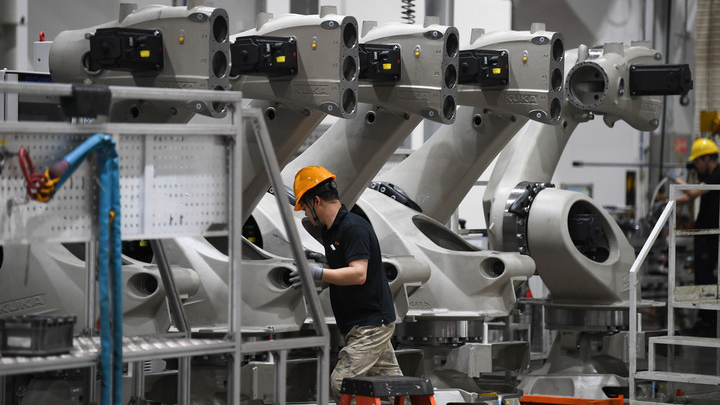
At the Industry Expo, Zhiyuan focused on the "industrial deployment state" and placed the Elf G2 series robots into four simulated workstations: optical module insertion and removal, cylinder head and valve assembly, loading and unloading of metal shells for car seat belts, and material box handling and stacking. From sub millimeter level precision operation to 50 kilogram peak load handling, the exhibition booth presents the capability boundaries of robots. To prove that these capabilities can be replicated on a large scale, it also depends on long-term operational data on the production line.
The report records a test conducted by Zhiyuan at Longqi Technology's Nanchang factory: 8 Elf G2 machines accumulated over 64 hours of operation and completed 64828 operations in 6 days of testing, with a comprehensive success rate of 99.99%. This slightly dull set of data is actually closer to the real concerns of the industry: whether robots can operate stably, how much human intervention is needed, and whether the overall cost is cost-effective.
The report summarizes the evolution of the industry into three curves: XYZ. The X-curve from 2022 to 2025 is a period of development and experimentation, with a focus on addressing issues such as whether robots can move stably and be mass-produced; The Y curve from 2026 to 2030 is the deployment growth period, during which robots need to shift from completing actions to steadily completing tasks; Afterwards, it is possible to enter the Z-curve characterized by the improvement of general abilities and the emergence of intelligence.
The so-called deployment state is not about moving the prototype to the production site, but about robots being able to operate normally and continuously deliver results in a real environment. This includes at least a complete set of system capabilities such as overall reliability, mass production consistency, model generalization ability, data closure, and operation and maintenance support. Zheng Zhongbin, Chief Expert of the Shanghai Innovation Center of the China Academy of Information and Communications Technology, stated that the demonstration presented the best performance, but the deployment required meeting the production line standards even under the most unfavorable conditions. The most urgent threshold at present is reliability engineering and acceptability, as well as forming a continuous evolution loop through real deployment.
The scene selection is therefore more pragmatic. Currently, embodied intelligence first enters the task fields of clear boundaries and quantifiable results such as handling, sorting, inspection, loading and unloading, and gradually expands to complex environments such as flexible assembly, commercial services, and homes. According to the report, if the success rate of a single action is 99%, the overall success rate of ten consecutive actions will decrease to about 90%. For industrial production, this means that robots must start from short chain, high certainty tasks and gradually extend the task chain during operation.
From a single skill to learning while doing
The difficulty of robots entering real scenes lies not only in the mechanical body, but also in coordinating the three abilities of motion, operation, and interaction.
The report summarizes this goal as "three intelligences in one". Early robots often trained modules such as movement, grasping, and dialogue separately, and their individual abilities were impressive. However, the information loss and error accumulation between modules were amplified in complex tasks. The new technical route attempts to use a unified model to link perception, decision-making and execution, so that robots can not only understand tasks, but also adjust their actions according to environmental changes.
According to the ability classification proposed in the report, the current development of robot ontology and interaction capabilities is relatively fast, and it is in the transition stage from L3 to L4; Sports intelligence is generally at the L3 level; The operational intelligence that directly determines the value of labor is still slightly lower than L3. Whether robots can stably complete tasks in the face of unfamiliar objects, changes in lighting, and human interference still needs more real-world testing.
Data is another hurdle. Text and pictures can be obtained from the Internet, but the robot training data needs to record vision, force, touch and action tracks, and also know why an operation succeeds or fails. The cost of real machine data is high, and there is a gap between simulated data and the real environment. The report suggests that embodied intelligence needs to shift from centralized data collection in the laboratory to robots learning while running in commercial scenarios, forming a closed loop of deployment, collection, training, updating, and redeployment.
The just concluded Global Developer Pioneer Conference further opened up this iterative process to developers. The conference will set up real-life training and workshops, where participants can operate real machines from companies such as Zhiyuan and Yushu on site; The demands of enterprises such as supermarket retail, quality inspection and testing, and energy inspection have been transformed into competition questions and reusable "skill packages". For the industry, the value of the developer ecosystem is not only to increase the number of applications, but also to enable the validation, accumulation, and reuse of experiences from different ontologies and scenarios.
This also explains why the actual deployment volume is more concerned than the pure shipment volume. A long-term running robot is both a production tool and a data entry point. The more deployment scenarios there are, the richer the long tail problems that the model is exposed to; Improved modeling capabilities may open up more scenarios. But whether this flywheel can turn still depends on whether the data format can be unified, how privacy can be protected, and whether data between different entities can be reused. Zheng Zhongbin summarized its bottlenecks as "not being able to communicate, not believing, and not changing": the data standards are not standardized, the credibility of simulation and real machine data lacks calibration, and the data ownership and profit distribution mechanism also need to be improved.
The turning point of scale depends more on hard indicators
The market's expectations for embodied intelligence are heating up. The China Development Report 2025 by the Development Research Center of the State Council predicts that the market size of China's embodied intelligence industry is expected to reach 400 billion yuan by 2030 and exceed one trillion yuan by 2035. The report also reminds that the long-term development of the industry still needs to pay attention to the thresholds that must be crossed for large-scale implementation, such as generalization ability, high-quality data, end-to-end computing power and power consumption, component durability, and system security.
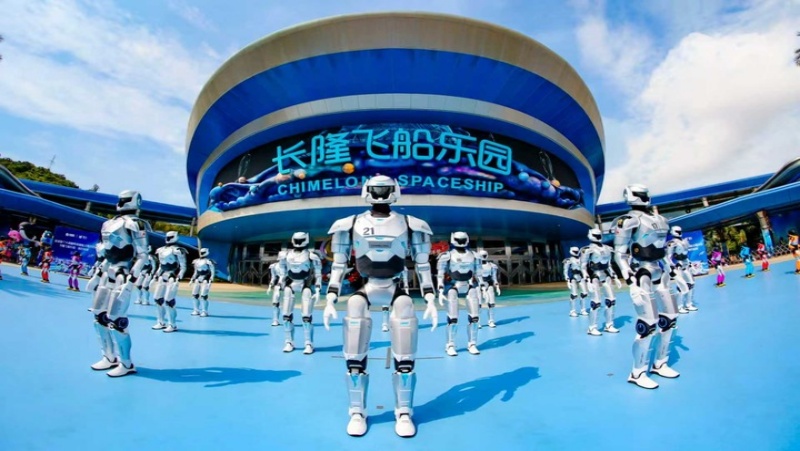
At present, the exploration of large-scale deployment has begun to extend from factory workshops to more open cultural and tourism scenes. On September 24th, Zhiyuan and Chimelong Group collaborated to launch the operation of embodied intelligent theme parks, with over 300 robots distributed in more than 100 interactive experience points, covering scenarios such as entertainment and commercial performances, science popularization research and learning, tour guidance and shopping, service retail, intelligent companionship, hotel services, and sports competitions. On the enterprise side, this large-scale normalized deployment is still a pioneering exploration in the industry. For the industry, its observational value does not lie in the robots' ability to perform, but in whether the robots can continue to operate in fluctuations in customer flow, open interaction, and multi scenario switching, and whether they can form maintainable and operable service samples.
But the increase in scenarios and deployment volume does not automatically mean the arrival of a turning point in scale. The task boundaries, interactive safety, and operational pace of theme parks are not the same as those of industrial production lines, and their deployment experience cannot be simply replicated in the manufacturing process. The true threshold for scaling still lies in hard indicators such as continuous operation time, effective task completion, manual takeover rate, comprehensive cost, and system security. Therefore, embodied intelligence still lacks a universally recognized value standard.
Traditional industrial robots are typically evaluated based on equipment price, start-up time, or return on investment for individual processes. The report introduces the concept of "effective intelligent working hours" proposed by Zhiyuan, which attempts to comprehensively measure the output of robots based on the number of active robots, actual effective working hours, and task value density. This indicator is still being explored by enterprises, and whether it can become a universal scale in the industry needs to be repeatedly verified in more scenarios.
Safety is a more stringent constraint than cost. Robots directly interact with the physical world, and a single recognition error or loss of control can lead to real-world consequences. The report suggests that security governance should be integrated throughout the entire process of hardware, algorithms, systems, and deployment, clarifying the responsibility boundaries of developers, users, and regulators, while strengthening data minimization collection, desensitization, and encryption protection.
Robots entering production and service scenarios should not be simply summarized as a replacement for humans. The report suggests that the more visible path at present is human-machine collaboration, allowing robots to undertake repetitive, high-intensity, or continuous tasks, unlocking new job positions and opportunities, and activating productivity value. Simultaneously evaluate employee rights, skill transformation, and safety responsibilities to coordinate technology application with human development.
Moving from exhibition booths to real-life scenarios means that embodied intelligence is beginning to undergo continuous testing in production and daily life. The lively action display will still attract attention, but what determines how far the industry can go will be another set of less eye-catching numbers: how long it will run continuously, how many effective tasks will be completed, how much manpower will be needed to take over, and whether the overall cost can be accepted by customers. Zheng Zhongbin stated that "acceptable" is an important sign of crossing the deployment threshold. (Outlook New Era)
Special statement: if the pictures and texts reproduced or quoted on this site infringe your legitimate rights and interests, please contact this site, and this site will correct and delete them in time. For copyright issues and website cooperation, please contact through outlook new era email:lwxsd@liaowanghn.com
 Recommended Reading Change it





















 Home

