
2026-11-26
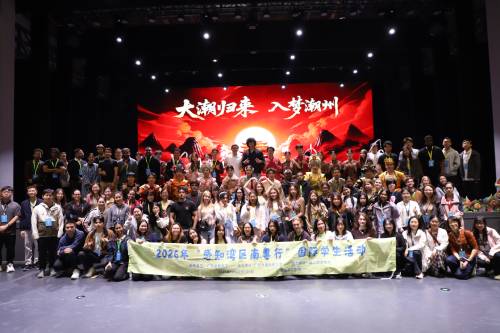
Measure Chaoshan with your footsteps and understand China while walking. From November 22nd to 24th, the "2026 'Perception of Southern Guangdong in the Bay Area' International Student Activity" was held in Shantou and Chaozhou, hosted by the Guangdong Provincial Department of Education, organized by Guangdong University of Foreign Studies, and co organized by Hanshan Normal University. 95 Chinese and foreign teachers and students (including international students and Chinese led teachers) from 31 universities in Guangdong Province visited Shantou, a famous overseas Chinese hometown, and Chaozhou, a famous Lingnan region, for a three-day in-depth study tour. The activity aims to help international students better understand and comprehend China, and then tell the story of China well, contributing their youthful strength to deepen friendly cooperation between countries.
This study tour is rich in content and multi-level, integrating cultural tracing, youth exchange, rural visits, and intangible cultural heritage experiences. International students have successively visited overseas Chinese exhibition halls, characteristic campuses, century old overseas Chinese villages, millennium ancient villages, etc. Through on-site observation, in-depth study, interactive experience, and discussion sharing, they immerse themselves in exploring the cultural context of Chaoshan overseas Chinese hometown, closely observe the achievements of rural revitalization and the "Hundred, Thousand, Thousand, and Ten Thousand Project" construction in eastern Guangdong, appreciate the traditional cultural heritage of Lingnan while walking, enhance understanding and friendship between Chinese and foreign youth through exchanges, and complete multi-dimensional and immersive cultural research and learning practices in the bay area.
Tracing the origins of overseas Chinese hometowns, understanding the patriotism that transcends mountains and seas through the history and criticism of overseas Chinese
In addition, the intangible cultural heritage of Chaoshan is an important component of China's excellent traditional culture, and also a vivid witness to the continuous inheritance of Chaoshan culture. It is an emotional bond that connects Chaoshan people at home and abroad. In addition to tracing the rich cultural heritage of overseas Chinese hometowns, international students also visited the Chaoshan Intangible Cultural Heritage Exhibition Hall to gain a visual understanding of the national, provincial, and municipal intangible cultural heritage projects that have been applied for and approved in the three cities of Chaoshan. "What impresses me most is Paper Cuttings", "What I like most is Chaozhou Opera", "What I like most is wood carving"... International students gradually understand why this profound local culture has become the constant spiritual root in the hearts of overseas Chinese when they stop to watch and understand various intangible heritage remains.
MIGUEL ANGEL PULLO MEJIA (Colombia) from Guangzhou University of Commerce is visiting Shantou for the first time. Before coming, he thought Shantou was a very small city, but after visiting and learning about it, he realized that Shantou has a developed economy and rich and diverse culture. This city has brought me surprises as much as I had hoped. I think it's a very beautiful place, and if given the opportunity, I would recommend my family and friends to come. I believe they will also love it.
At the Overseas Chinese Cultural Heritage Museum, international students have a close encounter with the world memory heritage site - Overseas Chinese Cultural Heritage. As the first national museum dedicated to overseas Chinese criticism, the museum houses over 120000 original versions of overseas Chinese criticism dating back a century. These "silver and trust in one" documents, which combine the warmth of family letters and the function of remittance, are precious physical evidence of modern overseas Chinese crossing oceans, supporting their families and filial piety, and conveying their longing. They are praised as the "Dunhuang documents of the 20th century" in China.
MENGDIBAIYZY KAMILA (Kazakhstan) and BAKHOVA SOFYA (Russia) from Guangdong University of Finance and Economics coincidentally shared with "Outlook on the New Era" that even though overseas, overseas Chinese in Chaoshan still care about their country and strive to make their homeland better within their capabilities. This emotion is very rare and touching. Having a hometown to rely on is a wonderful thing. The homeland can always give you strength and support, allowing you to persevere in difficult situations, "said BAKHOVA SOFYA. ”I feel like I have just started this journey of understanding the overseas Chinese community, and I want to slowly read through these letters and understand the stories behind them. ”MENGDIBAIYZY KAMILA added with emotion.
A thin sheet of paper, spanning thousands of miles, silently tells the nostalgia and responsibility of overseas Chinese for a hundred years, allowing international students to step out of the grand history and understand the patriotism in Chinese overseas Chinese culture from a micro and warm perspective. LEBRON FELIX MANUEL (USA) from Guangdong Normal University enthusiastically shared, "What touched me the most was that these letters constantly remind overseas travelers that even if they are in a foreign land, they are never alone. They are closely connected to their homeland and family. These overseas Chinese encourage them to persevere and maintain inner peace.
After cultural exchange, international students enter the school's science and technology innovation laboratory to immerse themselves in the achievements of modern science and technology innovation education in China. The laboratory covers multifunctional areas such as scientific experimental zone, astronomical exploration zone, maker practice zone, virtual reality experience zone, augmented reality experience zone, drone practice zone, robot competition zone, etc. Under the detailed explanation and guidance of our students, international students operate intelligent robots, experience drone control, and feel the combination of virtual and real intelligent technology, intuitively experiencing the innovative vitality and practical achievements of China's youth science and technology innovation education in the new era.
PARIYAKORN CHOUBOON (Thailand) from Dongguan Vocational and Technical College, as one of the sharing representatives, believes that such activities are very good, as they can learn a lot of new knowledge from the introductions of international students from different countries. Silas Paxton Emmanuel (USA) from Beijing Normal University Hong Kong Baptist University said, "I think Chinese education attaches great importance to self-discipline, and students are very disciplined. Everyone attends classes seriously, works hard, and hopes to find good jobs and succeed in the future. I believe that the schools here are preparing students for the next stage of life to adapt to society and the workplace.
As a typical demonstration village of Guangdong Province's "Hundred, Thousand, and Ten Thousand Project", Qianmei Village in Longdu Town, Chenghai District, Shantou City, has embarked on a path of integrated revitalization of "overseas Chinese culture+ancient villages+agriculture, culture, and tourism" based on its profound heritage as a hometown of overseas Chinese. According to the research advisor, this ancient village, which was founded in the late Yuan and early Ming dynasties and has a history of more than 600 years, is a famous hometown of overseas Chinese. The village preserves 58 Chaoshan overseas Chinese characteristic buildings, including the former residence of Chen Cihong. Among them, the former residence of Chen Cihong, known as the "first overseas Chinese residence in Lingnan", covers an area of 25400 square meters and has as many as 506 rooms. In recent years, Qianmei Village has used "overseas Chinese" as a bridge to connect the former residence of Chen Cihong with characteristic agricultural picking bases such as guava and jujube, making the quiet old houses a popular cultural and tourism destination. By 2025, Qianmei Village will receive about one million tourists. International students can intuitively experience the development effects of the "Hundred, Thousand, and Ten Thousand Projects" in preserving the charm of ancient villages, increasing rural income, and revitalizing rural areas between intangible cultural heritage exhibitions and picking fields.
Subsequently, the research team also visited Longhu Ancient Village in Chao'an District, Chaozhou City. This millennium old fortress, which was first built in the Southern Song Dynasty, is known as the "Exhibition of Chaoshan Ancient Architecture". After years, it still retains the complete "Three Streets and Six Alleys" layout, with over a hundred Ming and Qing dynasty ancestral halls and mansions arranged in a staggered manner. Longhu Ancient Village is also an important filming location for the popular overseas Chinese themed film "Love Letter to Grandma". The movie was filmed from locations such as the Huang Clan Ancestral Hall and Wuguan Lane within the village, telling the heartwarming story of Chaozhou people crossing the sea to search for their loved ones and caring for their homeland on the screen. This is closely related to the homesickness carried by Chaozhou Shantou overseas Chinese. International students stroll through the streets and alleys of ancient villages, studying the texture of ancient architecture, appreciating the historical context of the villages, and experiencing the millennium old residential wisdom and continuous local charm of Chaoshan among the bricks and tiles.
I have been to many ancient villages, but here is my favorite, "Silas, Paxton Emmanuel (USA) said confidently when mentioning the rural landscape of China. He originally thought that ancient villages would be dilapidated and old, but after arriving in Chaoshan, he found that the locals were very dedicated to maintaining these ancient buildings and admired the locals for being proud of them. I fully recognize China's strong support for rural development. I think the most rare thing is that they choose to protect these historical landmarks while developing.
After the immersive experience, all teachers and students watched the first intangible cultural heritage stage play in eastern Guangdong, "Returning from the Tide: Dreaming of Chaozhou" together. The play revolves around the descendants of Chaozhou overseas Chinese returning to their hometowns to search for their roots, connecting classic Chaozhou Shantou elements such as the Red Headed Boat crossing the sea, overseas Chinese sending thoughts, and the transmission of intangible cultural heritage. It integrates diverse intangible cultural heritage such as English songs and dances, Chaozhou dramas, Chaozhou gongs and drums, and overseas Chinese culture into the narrative of light and shadow. With the help of immersive stage and multimedia effects, the play vividly portrays the stories of Chaozhou people traveling on the waves, cultivating the four seas, caring for their homeland, and passing on the torch from generation to generation, constructing a long scroll of Chaozhou Shantou culture that transcends time and space.
This is the first time I have seen such a fascinating culture presented in the form of a stage play, "said GOGOI GHANIBHUTI (India) from the Hong Kong University of Science and Technology (Guangzhou)." Traditional culture should be protected in the process of striving for development. The Chaoshan region is constantly developing its economy, but it has not ignored the inheritance of traditional culture. The two are developing in parallel, which has greatly inspired it.
From personally experiencing painted facial makeup and dancing English songs, to immersing themselves in watching intangible cultural heritage stage plays, international students step out of shallow observation and deeply touch the Lingnan intangible cultural heritage context and the spirit of trendsetters through hands-on, dynamic, and emotional multidimensional experiences, truly experiencing the unique charm and craftsmanship of revitalizing and inheriting excellent traditional Chinese culture in the new era.
Special statement: if the pictures and texts reproduced or quoted on this site infringe your legitimate rights and interests, please contact this site, and this site will correct and delete them in time. For copyright issues and website cooperation, please contact through outlook new era email:lwxsd@liaowanghn.com
 Recommended Reading Change it












Submission mailbox:lwxsd@liaowanghn.com Tel:020-817896455
粤ICP备19140089号-4 Copyright © 2019 by www.outlooknewera.com.cn all rights reserved
>